What are the Stages of Custom eLearning Development?
In today’s highly interconnected yet significantly diverse world of business, the rise of an international workforce spread across the globe creates a challenge for traditional, in-person training. This, combined with ever-evolving business needs and a constant stream of new products and services, demands a more adaptable approach to employee training and development. This is where custom eLearning steps in. Custom eLearning design development allows organizations to create training courses that are specifically curated to address their employee skill gaps, learning objectives, and align with business goals. Custom eLearning solutions ensure that employees receive relevant knowledge and develop skills that help them stay up-to-date in the competitive environment and excel in their respective roles.
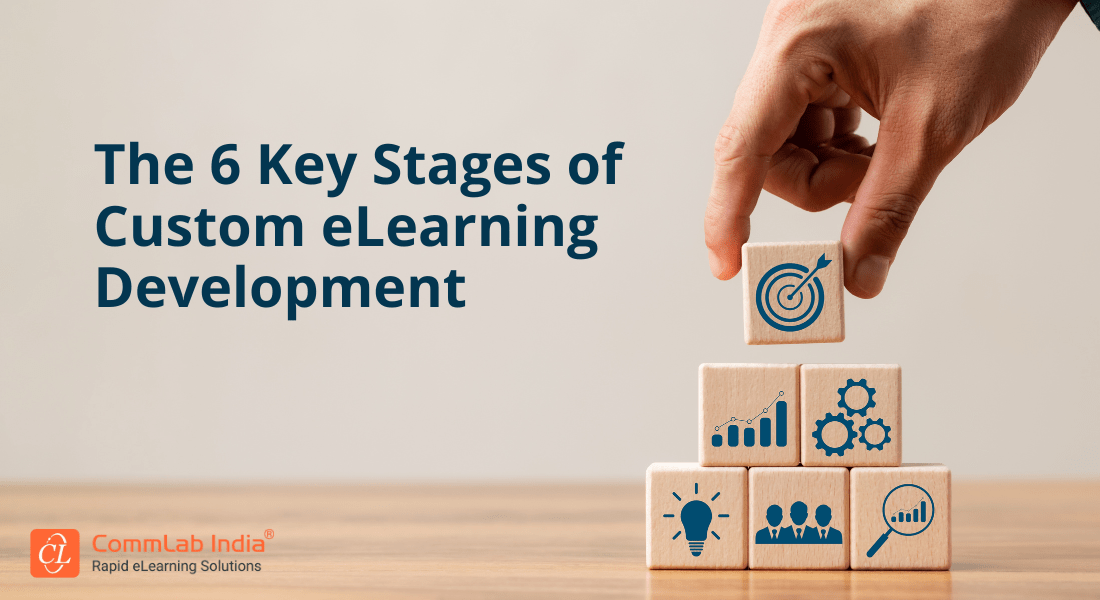
Custom eLearning typically follows six stages: analysis, design, development, evaluation & implementation, translation (if needed), and LMS hosting. Each stage reduces rework by clarifying requirements early, building learning flow before production, and validating quality before launch.
→ Download Now: Rapid eLearning — The 4 Rs for Corporate Training Success
Table of Contents
What is Custom eLearning?
Custom eLearning refers to online learning experiences that are specifically designed and developed to meet the unique needs of a particular learner or organization. It’s essentially the opposite of off-the-shelf eLearning courses, which are pre-made programs that cover general topics.
What Are the Benefits of Custom eLearning in Corporate Training?
Custom eLearning benefits corporate training by increasing engagement, improving knowledge retention, enabling measurable results, supporting scalability across teams and regions, and promoting flexible, accessible learning anytime and anywhere.
The sections below explain how each of these benefits contributes to more effective, consistent, and performance-driven corporate training outcomes.
1. Increases Engagement
We all love it when we can relate to what we’re learning, don’t we? Similarly, custom eLearning modules make the learning process so much more interesting and motivating for the learners. They also get to see how all that they’re learning is going to help them achieve their goals, thus boosting engagement and efficiency.
2. Improves Knowledge Retention
Along with increased engagement, custom eLearning also makes sure that what the learners learn sticks in their minds. When they can connect with what they’re learning in a way that makes sense to them, they’re more likely to remember it and use it in their daily lives.
3. Enables Measurable Results
We all want to know that what we’re learning is actually going to help us in the real world. Isn’t it? Custom eLearning allows you to track learner progress and measure the effectiveness of the training in achieving the desired outcomes.

Have You Met the 4 Rs of Rapid eLearning?
Accelerate Learning and Maximize its Impact With the 4 Rs of Rapid eLearning!
4Rs of rapid eLearning:
- Redesign
- Record
- Rebuild
- Republish
4. Supports Scalability
Custom eLearning can be easily scaled to accommodate a growing workforce or changing organizational needs. As companies expand, eLearning solutions can be updated or developed to address new training requirements without the need for significant additional resources. This flexibility helps organizations keep their training programs relevant and up-to-date.
5. Promotes Flexibility and Accessibility
Mobile eLearning is growing at a rate of 27% annually, driven by the increasing use of smartphones and tablets for learning.
Source: Forbes
With custom eLearning solutions, employees can access training materials at any time and from any location. This flexibility is especially beneficial for remote workers or those with busy schedules, as it allows them to fit learning into their day when it is most convenient. As a result, employees can continue to develop their skills without disrupting their work-life balance.
What are the Different Stages in the Custom eLearning Development Process?
The custom eLearning development process usually includes analysis, design, development, evaluation & implementation, translation, and LMS hosting.
- Analysis: Define learner needs, goals, constraints, and success metrics.
- Design: Decide learning strategy, structure, interactions, and assessment approach.
- Development: Build the course assets and interactions in authoring tools.
- Evaluation & implementation: QA, stakeholder review, fixes, and release.
- Translation (if needed): Adapt language and visuals for regions and cultures.
- LMS hosting: Deploy, track, report, and iterate based on learning data.
1. Analysis
This is the first step of the custom eLearning development process. At this stage, you need to analyze the learning content, learning objectives, and the profile of the target learners. You also need to look at the type of job or tasks that the participants are expected to accomplish after taking the course. Based on this, a broad instructional strategy is formulated to decide on the best way to present the content.
2. Design
Next, learning experts create a design document that incorporates the recommendations of the learning management team. Specific requirements of the stakeholders, preferred learning styles, training objectives, eLearning assessments required, and eLearning design challenges are considered at this stage. This document also specifies the instructional, visual, and audio elements to be included in the course curriculum.
3. Develop
The specifications in the eLearning design document are executed by incorporating the content, visuals, and assessments into a storyboard. There are a range of eLearning authoring tools today, such as Articulate Storyline, Articulate Rise, Elucidat and iSpring suite which can be used to give a definite shape to your custom eLearning course. These tools also expedite the custom eLearning course development process.
Check out this video that shares 4 tips to select the right authoring tool for your eLearning course development.
4. Evaluate & Implement
Next is the evaluation stage where the quality of the developed custom eLearning course is tested to ensure accuracy of functionality as well as content. Editors, instructional designers, subject matter experts, and quality control managers check various components of the custom eLearning modules to ensure perfection. Feedback is incorporated into the course and uploaded.
5. Translation
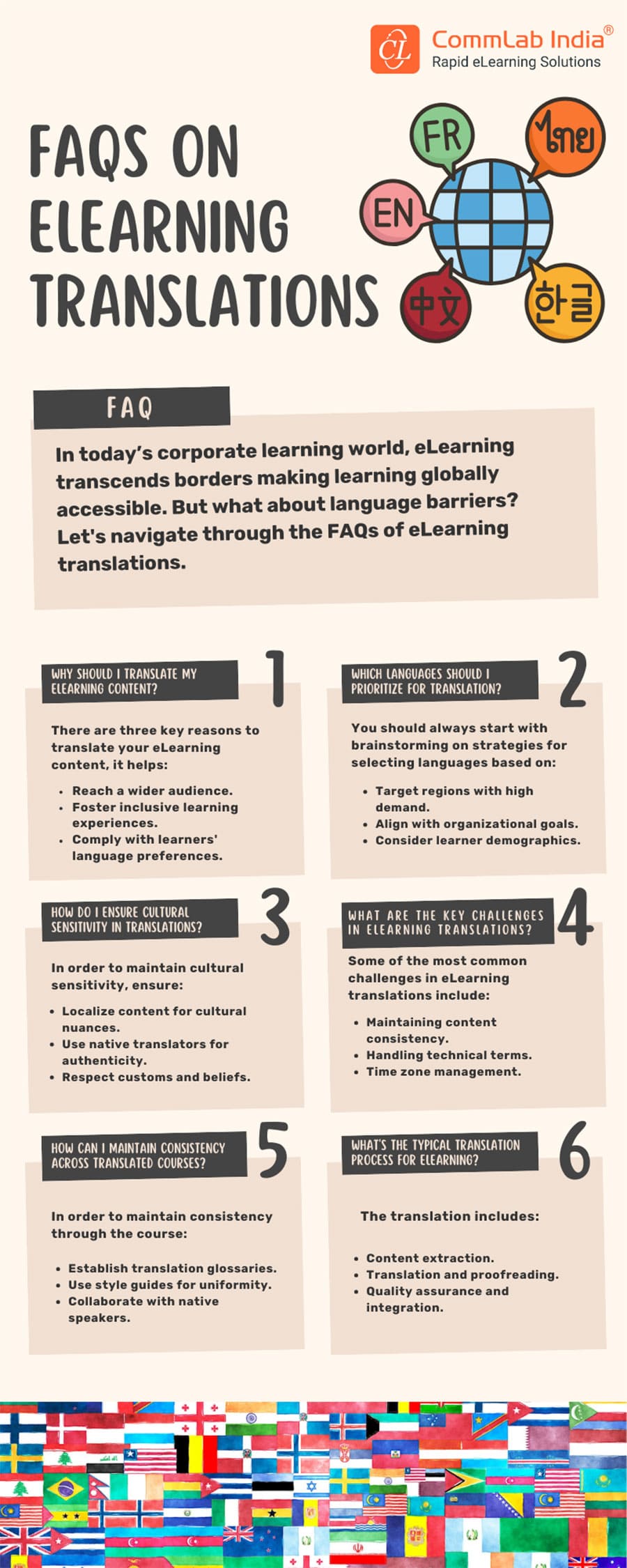
In custom eLearning development, translation is a critical stage when a course needs to be available in multiple languages. At this point, the content undergoes a structured sequence of actions to ensure both accuracy and quality in translation. This involves collaborating with professional translators who are not only fluent in the target languages but also familiar with the subject matter. The eLearning translation process includes translating text, adapting visuals, and ensuring cultural relevance, all while maintaining the integrity of the Teams can use AI-assisted translation tools such as DeepL, Smartcat, and similar platforms to accelerate turnaround while keeping human review in place.
Have questions about effective eLearning translations? Have a look at this infographic!
6. LMS Hosting
Finally, the course is hosted on the Learning Management System (LMS) or any other learning portal. Using an LMS allows training managers to monitor and evaluate the training program at every stage – how many users have registered, how many learners have completed, how many have abandoned mid-way, etc. This helps in taking corrective action and ensuring maximum success of the training initiative.
How to Design Effective Custom eLearning Courses?
The process of creating high-impact custom eLearning courses has adult learning principles, learning styles, and instructional design principles as its foundation. It ensures that the content is not only relevant but also engaging and effective for the target learner group.
Adult Learning Principles
Adults learn differently from children. According to the adult learning principles, adult learning:
- Is autonomous and self-directed
- Consists of different learning styles
- Is time-bound
- Is influenced by intrinsic and extrinsic factors
- Is problem-oriented and goal-oriented
- Emphasizes practical and relevant learning
- Brings prior knowledge and experience into learning
In the case of adult learners, you need to facilitate rather than teach. You need to connect the current learning to what they already know, and you need to make the learning solve the problems they face at the workplace. You must clearly articulate their most common query of “What’s in it for me.” Pay close attention to all these factors while designing custom eLearning courses and you’ll be good to go.
Instructional Design Principles
Finally, you must apply sound instructional design to facilitate learning for adults. There are many models of instructional design you can follow, depending on the learner profile and the subject at hand. But there’s one framework that helps you create and deliver information in a structured manner. It’s Gagne’s 9 Events of Instruction. It includes grabbing attention, informing learners of objectives, stimulating prior knowledge, presenting content, providing guidance, allowing practice, offering feedback, assessing performance, and enhancing retention.
There are many more models at the disposal of learning experts, and they need to choose the right one based on different situations. Designing learner-centric eLearning course involves the application of several principles and practices that are far more specialized than making a general one-size-fits-all eLearning course. This ensures that the custom eLearning course is effective, ensuring participants learn and apply what they learn to their jobs.
Watch this video to master applying instructional design principles in custom eLearning!
Why a Structured eLearning Development Process Matters
In conclusion, the custom eLearning development process works best when you lock requirements early, design before building, and validate quality before launch. Use the six-stage structure to reduce rework, improve learner experience, and make results easier to track. If you’re planning a new program, start by defining audience, objectives, and success metrics, then choose the right format and tool based on those constraints.
To accelerate learning and enhance engagement, consider leveraging the 4 Rs of Rapid eLearning. These offer a robust framework to rapidly convert traditional training content into dynamic online learning experiences. Want to delve deeper into how these strategies can transform your custom eLearning initiatives? Download our eBook on the 4 Rs of Rapid eLearning today!
Editor’s note: This post was originally published on July 11, 2024 and has been updated for comprehensiveness.

You may also like

Employee Development Planning: A Strategic Guide

AI Trends In L&D For 2026: Architecting Human-AI Capabilities