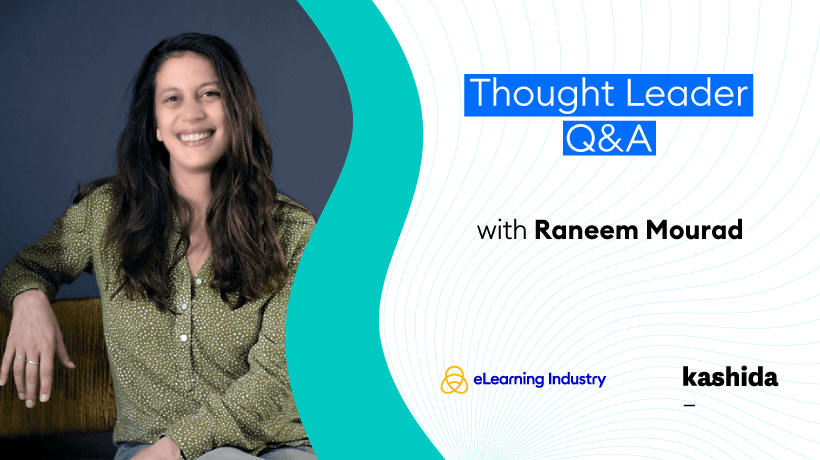
Thought Leader Q&A: Raneem Mourad From Kashida
What Does 2026 Have In Store For The eLearning Industry?
With over a decade of experience in marketing and advertising, Raneem Mourad transitioned to the EdTech sector in 2013 and became the Managing Partner at Kashida in 2016. Kashida designs and produces bespoke, impactful eLearning content across platforms to meet the unique needs of its clients. As the Partner & Director of Growth at Kashida, Raneem leads a team of talented designers, developers, and Learning Experience Designers, as well as oversees the business development, market research, and client relations aspects of the company. Today, she speaks with us about what 2026 will bring for EdTech and eLearning based on her work with global organizations and custom learning design experience.
This past year has brought its fair share of innovations in the eLearning field. What should L&D leaders be excited about in 2026?
So much to be excited about. But what I think L&D leaders should be most excited about is the fact that we now have more flexibility than ever in how learning is designed and delivered. The question is no longer what technology we should use, but rather what kind of experience do learners actually need? That shift in mindset opens the door to far more meaningful, context-aware learning—whether through digital programs, blended formats, or more immersive experiences.
What excites me most about 2026 isn’t a single technology or trend; it’s the growing maturity of the eLearning field itself. We’re finally moving away from chasing tools for their own sake and toward more thoughtful conversations about purpose, impact, and relevance.
I’m also seeing a much stronger focus on adaptability. Organizations are increasingly aware that learning can’t be static anymore. It needs to evolve alongside people, roles, and priorities. In our work, this has meant designing learning experiences that can grow over time, rather than being locked into a single format or platform.
Overall, 2026 feels like a moment where L&D can further embrace its strategic role: less about content production, and more about enabling real capability building.
Based on your years of experience in custom learning development, how do you think technology, design, and strategy are evolving?
One of the most important changes I’ve observed is that technology, design, and strategy are no longer being treated as separate conversations. The most effective learning initiatives today are the ones where these three elements are intentionally aligned from the start.
Design, in particular, has taken on a much more strategic role. Learning experience design isn’t just about structuring content or adding interactivity—it’s about understanding learners, organizational realities, and desired behaviors, and then making deliberate choices about how technology can support those goals.
In many of the projects we work on, technology decisions come after deep design conversations. That sequencing matters. It allows technology to act as an enabler rather than a constraint. As tools continue to evolve, this approach also gives organizations more resilience—they’re not tied to a single solution, but to a clear design logic that can adapt over time.
Ultimately, this evolution shows that strong learning outcomes don’t come from innovation alone. They come from thoughtful integration—when strategy sets direction, design provides structure, and technology supports execution.
How can organizations prepare for a rapidly shifting digital learning landscape? Why is it so critical for them to focus on human-centered design?
The way I see it, the best way organizations can prepare for change is by grounding their learning efforts in a deep understanding of people. Technologies will continue to shift, but learners—their motivations, pressures, and constraints—remain the most important constant.
Human-centered design helps organizations build learning that’s resilient. When experiences are designed around how people actually work and learn, they can evolve without losing relevance. I’ve seen many organizations invest heavily in platforms, only to realize later that the learning doesn’t translate into real behavior change. That usually happens when design decisions aren’t rooted in learner realities.
A human-centered approach forces important questions early on: What problem are we solving? What does success look like for learners? What barriers might they face? Those questions shape everything that follows, including how technology is used.
Preparing for a shifting landscape isn’t about predicting the future perfectly. It’s about creating learning ecosystems that are flexible, empathetic, and aligned with real organizational goals. When you design from the human perspective, adapting to whatever comes next becomes much more manageable.
Can you tell us a bit more about Kashida’s design methodology and how it helps you (and your clients) navigate the shifts in technology?
We made a strategic decision over ten years ago that our design methodology would always start with people, not platforms. Every project begins by understanding learners, context, and the kind of change the learning is meant to support. Only then do we make decisions about formats, tools, or technologies.
It hasn’t always been easy to convince clients to start with a design strategy first. Many initially want to know what the final output will look like before committing. But once they go through our LXD process and experience it firsthand, trust builds—because the outcomes are more meaningful, relevant, and impactful for both learners and the organization.
This human-centered, tech-agnostic approach allows us and our clients to navigate technological shifts with confidence. For example, in programs like NetHope’s Women Leaders initiative, where learners come from highly diverse cultural and professional contexts, starting with design strategy allowed the learning experience to remain coherent and relevant even as delivery formats evolved.
Across very different types of projects, we’ve seen how this methodology creates continuity, even when technology changes midstream. Because the design logic is clear, new tools can be integrated thoughtfully rather than disruptively. That’s what ultimately makes learning feel future-ready.
What role do you believe AI plays in the future of custom learning design, and where do you think the AI-human collaboration is heading?
There are many ways we’re already seeing AI play a role in custom learning. From a design perspective, I see AI as a powerful support—not a replacement. Its real value lies in how it enhances human expertise, particularly by improving efficiency and opening up new possibilities for personalization and scale.
We’re already using AI to streamline parts of the development process, giving our learning designers more space to focus on what truly requires human judgment: understanding context, navigating complexity, and designing experiences that drive meaningful change. For us, AI elevates the role of the learning designer rather than diminishing it.
AI has also become a powerful tool in production. It allows us to develop pilots quickly—testing ideas, visuals, or narrative directions early—so clients can align on strategy through tangible examples in a more cost- and time-efficient way. This has been especially valuable in projects dealing with complex or sensitive topics, such as our work on digital financial literacy, where iteration and clarity are critical.
Looking ahead, I see AI-human collaboration moving toward a more intentional partnership. We define the goals, values, and ethical boundaries; AI supports exploration, adaptation, and responsiveness. The risk, of course, is using AI without a strong design foundation. Without that, it can remain superficial—or, worse, introduce cultural or contextual inaccuracies.
When grounded in human-centered design and clear learning objectives, AI becomes a tool that genuinely expands what’s possible, while keeping people firmly at the center of the learning experience.
Wrapping Up
Thanks so much to Raneem for sharing her insights on human-first learning design and navigating L&D challenges. If you’d like to explore how Kashida can support your 2026 learning strategy, you can get in touch today to book your 30-minute free consultation and discuss your specific needs.
Source link

You may also like
Lessons Learned In 2025: If I Were An LLM
The 2026 Data Skills Roadmap – Dataquest