The Definitive Guide to Adjectives Ending in C
Adjectives ending in C are distinctive in the English language. Unlike the sensory simplicity of words ending in D or T (such as red or hot), adjectives terminating in C are rarely foundational “Tier 1” vocabulary.
Instead, these words form the backbone of academic, scientific, and sophisticated descriptive language. They provide the crisp, abrupt stop sound (/k/) that characterizes precise communication. Mastering these adjectives is essential for students transitioning from descriptive speaking to formal writing across the curriculum, particularly in STEM subjects. This guide provides educators with the morphological context of these words, tiered vocabulary lists, and engaging activities to support their acquisition.
Link to Hub: The Ultimate Teachers Hub: Adjectives Ending in Every Letter
The Morphology of “C”: The “-ic” Suffix
Almost without exception, adjectives ending in C utilize the suffix -ic. This is a powerful morphological tool derived from the Greek ikos and the Latin icus.
Understanding this suffix is the key to teaching these words effectively.
The Meaning of “-ic”
The suffix -ic simply means:
- “Of or pertaining to”
- “Having the nature of”
- “Like” or “characterized by”
By teaching this rule, students can unlock the meaning of complex new words by identifying the root noun.
- The Root Noun: Hero – The Adjective: Heroic (Like a hero).
- The Root Noun: Atom – The Adjective: Atomic (Pertaining to atoms).
- The Root Noun: Artist – The Adjective: Artistic (Having the nature of an artist).
Spelling Note: Teachers should highlight that when a root word ends in ‘y’, it often changes to an ‘i’ before adding ‘-ic’ (e.g., History – Historic).

Categorized Lists of Adjectives Ending in C
These lists are organized by letter count to support differentiated instruction, phonics teaching, spelling lists, and vocabulary development in specific subjects.
3 and 4-Letter Adjectives Ending in C
There are very few short adjectives ending in C in common English usage.
- Chic: (Loanword from French) Stylishly fashionable.
- Epic: Heroic or grand in scale or character. (Often used informally to mean “impressive”).
5-Letter Adjectives Ending in C
- Basic: Forming an essential foundation or starting point; fundamental.
- Civic: Relating to a city or town, especially its administration; or relating to the duties of a citizen.
- Magic: Having or apparently having supernatural powers. (Also a noun).
- Sonic: Relating to or using sound waves.
- Stoic: Enduring pain and hardship without showing one’s feelings or complaining.
- Toxic: Poisonous.
6-Letter Adjectives Ending in C
- Acidic: Having the properties of an acid, or containing acid; having a bitter or sharp taste.
- Exotic: Originating in or characteristic of a distant foreign country.
- Hectic: Full of incessant or frantic activity.
- Iconic: Relating to or of the nature of an icon; widely recognized and well-established.
- Ironic: Using or characterized by irony (saying the opposite of what you mean).
- Public: Of or concerning the people as a whole.
- Scenic: Providing or relating to views of impressive or beautiful natural scenery.
- Static: Lacking in movement, action, or change.
7-Letter Adjectives Ending in C
This category is rich with academic vocabulary.
- Aquatic: Relating to water.
- Archaic: Very old or old-fashioned.
- Chronic: (Of an illness or problem) persisting for a long time or constantly recurring.
- Dynamic: (Of a process or system) characterized by constant change, activity, or progress.
- Elastic: Able to resume its normal shape spontaneously after being stretched or compressed.
- Generic: Characteristic of or relating to a class or group of things; not specific.
- Graphic: Relating to visual art, especially involving drawing, engraving, or lettering; OR giving vivid detail.
- Organic: Relating to or derived from living matter.
- Plastic: (Of a substance or material) easily shaped or molded.
8-Letter Adjectives Ending in C
- Artistic: Having or revealing natural creative skill.
- Athletic: Physically strong, fit, and active.
- Dramatic: Relating to drama or the performance or study of drama; OR sudden and striking.
- Electric: Relating to, worked by, or producing electricity.
- Gigantic: Of very great size or extent; huge or enormous.
- Historic: Famous or important in history.
- Specific: Clearly defined or identified.
- Terrific: Of great size, amount, or intensity; OR extremely good.
9-Letter Adjectives Ending in C
- Automatic: Working by itself with little or no direct human control.
- Fantastic: Extraordinarily good or attractive.
- Pragmatic: Dealing with things sensibly and realistically in a way that is based on practical rather than theoretical considerations.
- Realistic: Having or showing a sensible and practical idea of what can be achieved or expected.
- Strategic: Relating to the identification of long-term or overall aims and interests and the means of achieving them.
10+ Letter Adjectives Ending in C
- Atmospheric: Relating to the atmosphere of the earth or (another) planet.
- Catastrophic: Involving or causing sudden great damage or suffering.
- Enthusiastic: Having or showing intense and eager enjoyment, interest, or approval.
- Scientific: Based on or characterized by the methods and principles of science.
- Sympathetic: Feeling, showing, or expressing sympathy.

Teaching Activity: “Magic or Scientific?”
Because so many adjectives ending in C are related to science and properties of matter, they lend themselves to engaging, hands-on experiments. This activity follows the Attention Autism framework to build academic vocabulary.
Target Vocabulary: Magic, Static, Elastic, Fantastic, Scientific.
Stage 1: The Bucket (To Focus Attention)
- The Hook: Sing the bucket song.
- The Reveal: Remove items that demonstrate the target adjectives, focusing on things that seem puzzling.
- A magician’s wand. “Look. It is magic.”
- A super-stretchy rubber band or slime. Stretch it extremely far. “Wow. It is elastic.”
- A balloon rubbed on hair so it sticks to the wall. “Look! It is static.”
Stage 2: The Attention Builder (To Sustain Attention)
- Activity: “The Bending Water Experiment.”
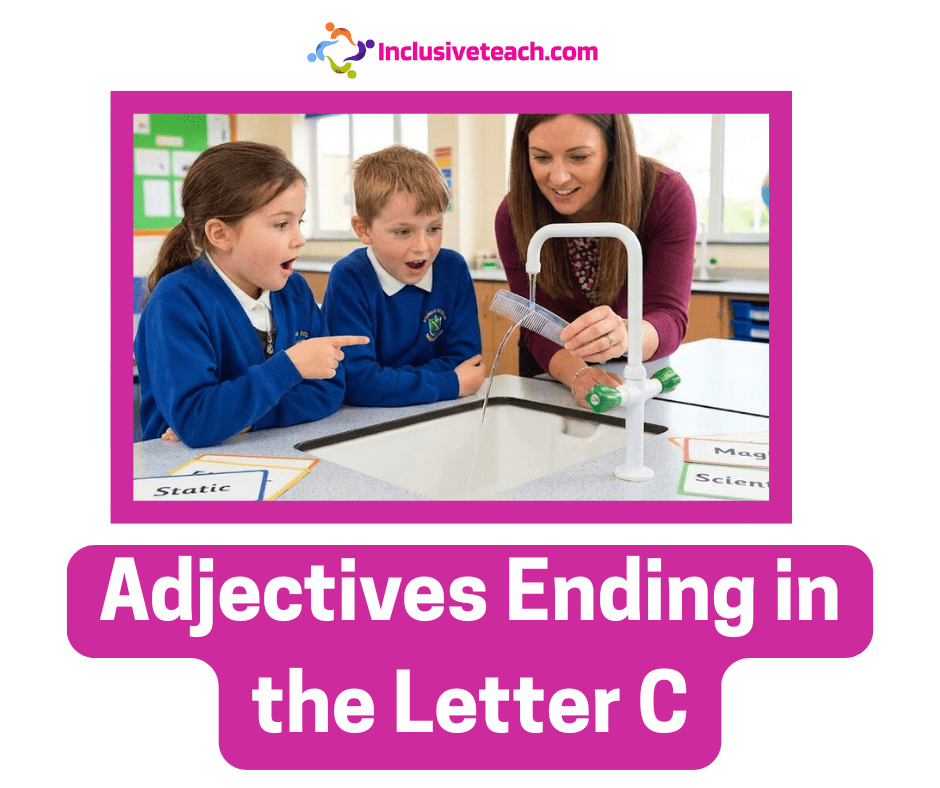
- Materials: A plastic comb or inflated balloon, a running water faucet with a very thin stream.
- Narrative:
- “Watch the water. It is falling straight down.”
- “Now, I need to create static energy.” (Rub the comb/balloon vigorously on wool or hair dramatically).
- “Watch. Is it magic? Or is it scientific?”
- Move the charged object near the water stream. The water will visibly bend toward the object.
- “Wow! That is fantastic! The static pulls the water.”
Stage 3: The Interactive Game (To Shift Attention)
- Game: “Static Sorcerers.”
- Setup: Provide small groups of students with balloons and a pile of paper confetti or tissue paper ghosts.
- Action: Students must generate a static charge to make the paper jump up to the balloon.
- Prompt: “Rub it fast! Make it static! Lift the paper!”
- Peer Interaction: Students cheer when their peers successfully make the paper jump.
Stage 4: Independent Activity (To Consolidate Skills)
- Task: The “Lab Report” Sorting.
- Materials: A worksheet with two columns: a wizard hat (labelled MAGIC) and a microscope (labelled SCIENTIFIC).
- Action: Students are given picture cards of various phenomena (e.g., a flying dragon, a rocket launching, a potion bubbling, a magnet picking up metal). They must sort them into the correct category.
- Extension: Students pick one “scientific” item and write a sentence using an ‘C’ adjective: “The rocket is dynamic.”
For further resources, complete letter lists, and printable materials, please visit our central directory: The Ultimate Teachers Hub: Adjectives Ending in Every Letter.
Related
Discover more from Special Education and Inclusive Learning
Subscribe to get the latest posts sent to your email.
Source link

You may also like
Understanding the Concrete-Pictorial-Abstract (CPA) Approach
Words That Sound the Same: A Visual Homophone Guide