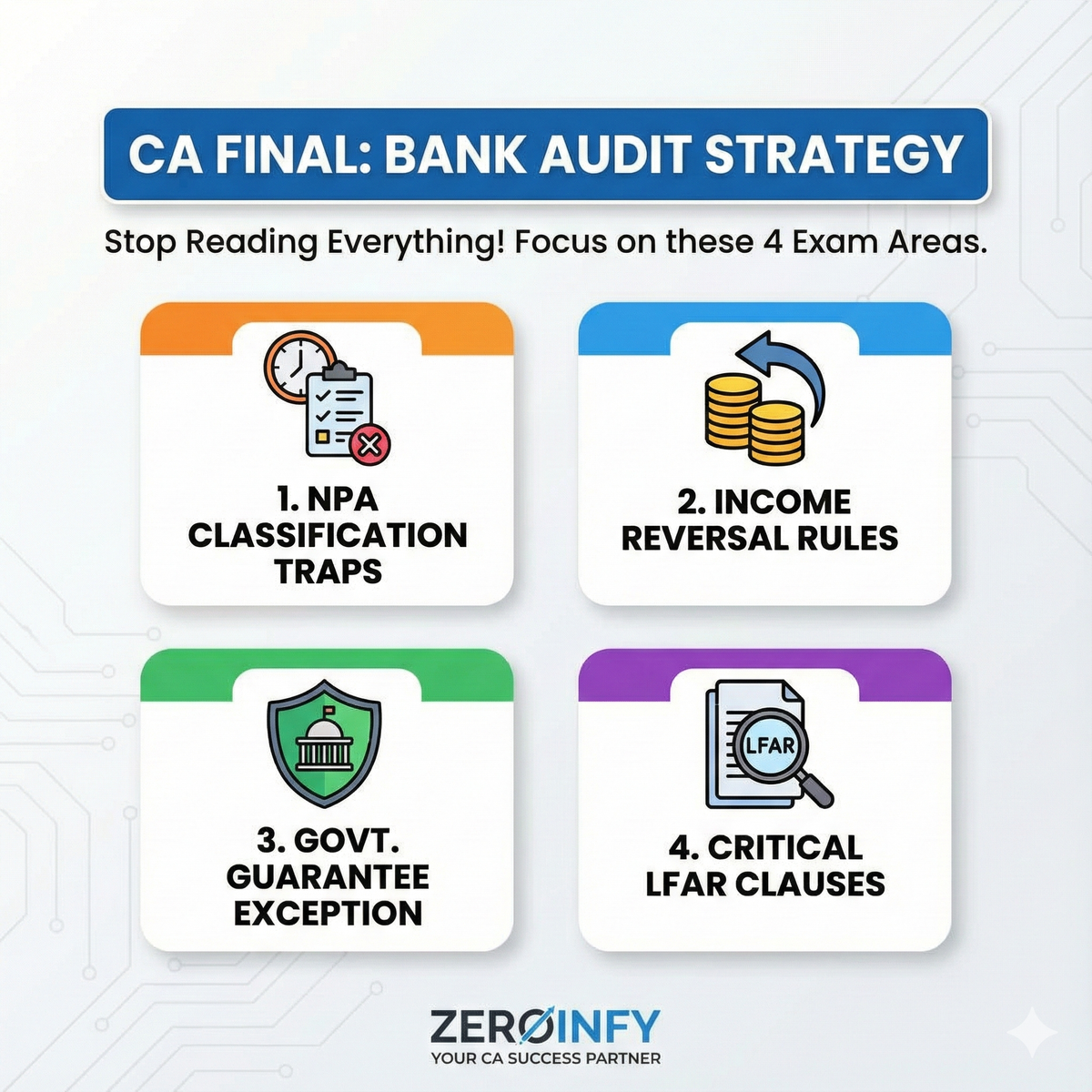
The 4 “High-Yield” Areas for CA Final
The “High-Yield” Focus Areas for CA Final Exams
Reality Check: If you analyze recent papers (Nov ’24 through Sep ’25), a clear pattern emerges. The examiner isn’t testing your ability to memorize 100 pages; they are testing your ability to handle 4 specific practical scenarios.
To secure a score of 60+ in Audit, stop “General Reading” and start “Strategic Targeting.”
#1 NPA Classification
Exam Weightage: 4-6 Marks (High Probability)
The most common question format gives you borrower data (Sanction Limit, Drawing Power, Due Dates) and asks for classification. Master these adjustments:
| Scenario / Trap | The Correct Audit Adjustment |
|---|---|
| Expired Stock Statement | If statement is > 3 months old, Drawing Power (DP) is NIL. Account becomes NPA if balance > 0. |
| Term Loan Overdue | NPA only if overdue for more than 90 days (start counting from the 91st day). |
| Erosion of Security | Value < 50% = Doubtful. Value < 10% = Loss Asset (Straightaway). |
#2 Income Reversal
The golden rule for exams: Income from NPA is recognized ONLY on a CASH basis.
🚩 The Exam Trap:
“The bank credited Rs. 5 Lakhs interest (accrual) to P&L for a loan that turned NPA this year. Only Rs. 1 Lakh was actually received.”
✅ The Solution:
The entire Rs. 5 Lakhs must be reversed from the P&L. You can only recognize the Rs. 1 Lakh that was actually realized.
#3 Govt. Guarantee Exception
Do not confuse Central and State guarantees. This is a favorite area for MCQs.
- Central Govt Guarantee: Treated as Standard Asset for classification (even if overdue). However, income is NOT recognized unless realized.
- State Govt Guarantee: No special treatment. If overdue > 90 days, it becomes NPA.
#4 Critical LFAR Clauses
Don’t memorize the whole report. Focus on these 3 clauses frequently seen in Case Scenarios:
- Clause 5 (Advances): Checks for “Quick Mortality” (accounts turning NPA within 12 months) and “Evergreening.”
- Suspense Accounts: Reporting old outstanding entries that may hide fraud.
- Cash Retention: Reporting if cash balances consistently exceed the prescribed limit.
Final Verdict
When revising Chapter 14 (Audit of Banks), prioritize these practical adjustments. The difference between a 40 and a 60 often lies in getting these technical nuances right.
Source link