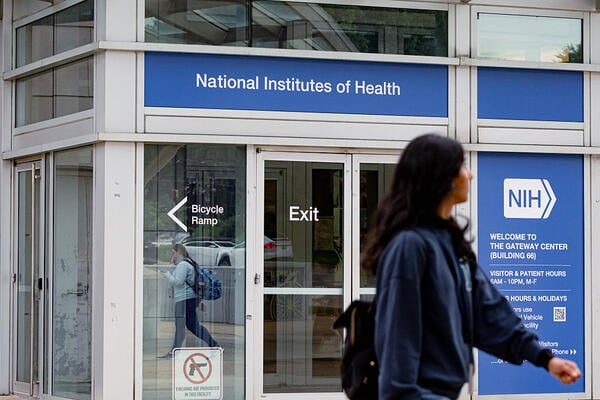
Judges Cite Supreme Rulings, Still Block NIH Indirect Costs Cap
The NIH’s attempt to cap indirect research cost reimbursement rates remains blocked.
Wesley Lapointe/The Washington Post via Getty Images
A federal appeals court is keeping in place the ban on the National Institutes of Health’s attempt to cap indirect research cost reimbursement rates for universities and researchers who receive its grant money.
The decision preserves institutions’ access to billions of dollars for annual expenses, such as lab costs and patient safety, which are not easily connected to specific projects. The NIH negotiates individual reimbursement rates with each institution, but a cap would change that and limit funding. U.S. District Court of Massachusetts judge Angel Kelley first blocked the rate cap last February, and it has remained blocked since.
Heather Pierce, senior director of science policy for the Association of American Medical Colleges—part of a panoply of groups, universities and states that sued to stop the cap—noted that “at all stages, from Feb. 10 on, the courts have maintained that NIH cannot implement that change.”
In their unanimous decision Monday upholding the block, three First Circuit Court of Appeals judges cited Supreme Court rulings in other lawsuits last year over the NIH’s termination of thousands of grants and the Education Department’s nixing of more than 100 grants for teacher and school leader recruitment and training. In both preliminary Supreme Court decisions, a slim majority of the justices said litigation over canceled contracts likely needed to go through the Court of Federal Claims and that regular district courts likely lacked legal jurisdiction.
But in last year’s ruling about the NIH’s grant terminations, Justice Amy Coney Barrett wrote in a majority decision that a district court likely did have jurisdiction to rule that the NIH’s guidance, upon which it based the grant cancellations, was illegal. The First Circuit reasoned Monday that the NIH’s blocked attempt to cap the indirect cost reimbursement rate at 15 percent is a policy like that guidance.
“Justice Barrett’s concurrence in that case plainly distinguishes between challenges to agency-wide policies, which belong in district court, and challenges to the withholding of contractually awarded funds that result from those policies, which belong in the [Court of Federal Claims],” First Circuit judge Kermit V. Lipez wrote for the appeals court.
Having concluded that the district court had jurisdiction to make its ruling, the appeals court decided to uphold its ruling. It said a complicated appropriations act rider that Congress has repeatedly re-enacted limits the NIH’s freedom to cap indirect cost rates.
“Per NIH’s own public statement on Twitter, the Supplemental Guidance’s displacement of negotiated rates would lead to $4 billion in annual savings,” Lipez wrote. “That is, NIH’s imposition of a 15% indirect cost reimbursement rate would lead it to withhold $4 billion.”
A spokesperson for the Health and Human Services Department, which includes the NIH, said the department had no comment.

Source link