How One University Trains and Retains Rural Care Providers
At a rural clinic on a Native American reservation, Nina Sanfilippo encountered a model of care designed to keep patients—and aspiring health-care providers—rooted in their community.
Sanfilippo, a third-year physician assistant student at Touro University, spent 12 weeks in a clinical rotation in Covelo, a quiet, rural town in Northern California where the closest hospital and medical specialists are nearly two hours away. The clinic, one of several where Touro students complete their rotations, serves a close-knit community shaped by systemic inequities and long-standing barriers that shape how residents seek and receive care.
“Watching all of these amazing providers work tirelessly—not only to care for their patients, but to make sure they feel heard and taken seriously—really blew me away,” Sanfilippo said. “Everyone was so collaborative and motivated to take care of their own community.”
Across the country, rural communities face persistent shortages of physicians and dentists, despite decades of policy attention. Sanfilippo is one of many medical students at Touro University who are part of the institution’s effort to address those gaps through locally centered training models designed to keep providers where they’re most needed.
Touro has taken a place-based approach in two states—California and New Mexico—using its medical and dental schools to build clinics and workforce pipelines focused not just on training but on rural retention.
Alan Kadish, Touro’s president and a physician himself, has been a driving force behind the institution’s investment in rural health care, choosing to open satellite colleges in rural communities and train providers to help fill long-standing gaps.
“The main thing that convinced us was the magnitude of the problem,” Kadish said. “In many of the places where we’ve opened schools, we’ve found that rural health indicators are poor.”
“We are not a major provider directly in rural health care, but we are collaborating in a number of ways with many of the people who deliver health care rurally,” he added, noting that the institution has worked on telemedicine and teledentistry initiatives to reach residents who live far from a hospital or clinic.
Kadish said those partnerships are central to Touro’s strategy, allowing the institution to support care delivery in the communities it serves.
“We partner with the local communities where we are and try to understand local culture—the way local health-care systems and government work—and try to interact with them positively,” Kadish said. “It has been a conscious effort, and one that’s needed to make a difference.”
California’s rural care: Tami Hendriksz, dean and chief academic officer of Touro University California College of Osteopathic Medicine, has led the institution’s investment in rural communities in California through expanded outreach and partnerships with underresourced local clinics. The initiative increases health-care access while giving students hands-on, community-based training, aligning with the university’s commitment to reducing health inequities.
As a result, 21 percent of its graduates now practice in underserved areas and 8 percent in rural communities—the highest proportion of any medical school in the state, according to the National Center for the Analysis of Healthcare Data.
“We’re here to address the workforce shortages, and in order to do so, you really have to partner with rural communities,” Hendriksz said.
Just as importantly, the model emphasizes residency placement and long-term retention in rural regions, with many graduates choosing to stay and practice in the same communities where they trained.
“We’re the only medical school in the country that has a program learning outcome of structural competency,” Hendriksz said. “The way I describe structural competency is we’re not just teaching our students about the social determinants of health, but we’re taking it a step further to talk about why those social determinants of health exist.”

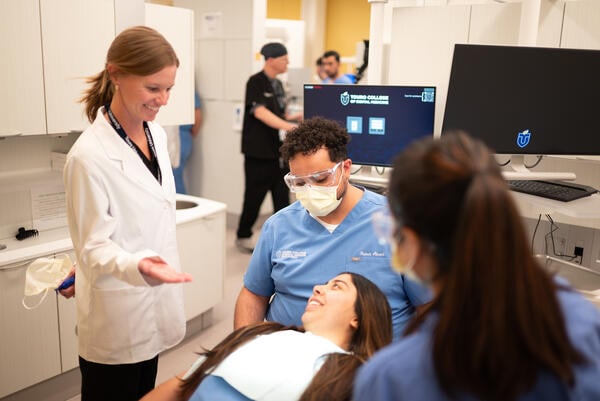
A Touro University physician assistant trainee practices clinical skills.
New Mexico’s oral health: Ronnie Myers, dean of Touro’s College of Dental Medicine, said New Mexico had never had a dental school before the institution opened its doors.
“That brings up a whole set of issues … because it’s clearly known that people who go to school or are educated in an area are more likely to stay in that area when they’re done,” Myers said. “That’s truly written in the literature as far as residencies are concerned.”
Touro launched the state’s first dental school and clinic in Albuquerque to address one of the nation’s lowest dentist-to-resident ratios. Myers said the national average is about 61 dentists per 100,000 residents; in New Mexico, it’s about 42 per 100,000—and the state has seen a roughly 10 percent drop in dentists over the past decade.
“New Mexico is one of the highest Medicaid-population states in the U.S., so the number of underserved and underinsured is high,” Myers said. “The potential for people leaving because of reimbursement is high, especially given the debt of dental students.”
The program focuses on recruiting students with ties to New Mexico and training them locally, while building a long-term dental workforce for rural and underserved areas in the state.
“They enjoy the area, and many of them have expressed the idea that this might not be a bad place to live and practice,” Myers said.
Keeping care local: Hendriksz said Touro’s training model is already showing results in retaining clinicians in rural communities.
“The most successful way to keep clinicians in rural, underserved areas is to recruit them from those areas,” Hendriksz said. “We’re seeing what the local workforce shortages are, and we’re reaching out to the high schools, middle schools and community colleges to help set up some of those pathways.”
She added that attacks on diversity, equity and inclusion have made it even more important to find ways to produce clinicians who look like the communities they’re serving.
“One of the best ways to do that is to bring people from those communities that are committed and invested in those communities, because it’s their family, it’s where they’re from,” Hendriksz said.
Myers agreed, adding that universities need to be willing to take those types of risks to improve their programs.
“You see a need, and you see something that you believe will increase health-care access and get students to understand what it means to be community players and so on—but if you don’t have the university to say, ‘This is something we want to do,’ well, you may not get to,” Myers said.
Ultimately, Myers said the early outcomes suggest that place-based recruitment and training can make a measurable difference in addressing provider shortages and improving local health care access.
“Whether it’s dentistry, whether it’s primary health care, whether it’s emergency care, I think it’s important to … expand what your footprint can be,” Myers said.
(This story has been updated to correct Tami Hendriksz’s title. She’s the dean and chief academic officer of Touro University California College of Osteopathic Medicine.)
Get more content like this directly to your inbox. Subscribe here.
Source link

You may also like

Why Colleges Shouldn’t Ban Bullying

Weekly Student News Quiz: Super Bowl, Olympics, Missing Person