Grief Fuels Expansion of Turning Point’s Campus Footprint
In the hours after Charlie Kirk’s assassination last month, RaeAnna Morales was overcome with disbelief, anger and sadness.
“I saw a video of him being shot and I was absolutely horrified. That’s not something you can ever completely get out of your head,” Morales, a political science major and media director for the College Republicans at Vanderbilt University, told Inside Higher Ed. “He was out there speaking to both political parties. No one should get shot for expressing a political viewpoint.”
She canceled her plans for the rest of the day and reflected on how she could channel her grief. “I realized what I can do is bring Turning Point to Vanderbilt’s campus,” she said. “That night, I reached out to [Turning Point] and asked if we could start a chapter.”
Morales’s request was one of 62,000 that Turning Point USA—the group Kirk founded in 2012 “to identify, educate, train, and organize students to promote the principles of freedom, free markets, and limited government”—received from students interested in starting a new chapter or getting involved with one in the eight days after his death, the group posted on X.
“It’s not just a movement anymore, it’s a nationwide awakening,” one commenter replied. “They tried to silence him. Instead, they lit the fuse.”
One month later, momentum for the conservative movement Kirk started on college campuses more than a decade ago appears stronger than ever.
Kirk’s supporters, including President Donald Trump and his Republican allies, immediately moved to canonize him as an exemplar of Christian values and civic debate—and called to punish anyone, including professors, who publicly disagreed. Donations from conservative donors are pouring in to Turning Point, which has adopted “We are Charlie Kirk” as its new mantra. And after the artist Bad Bunny, who has criticized Trump’s immigration policies, was selected to headline the 2026 Super Bowl halftime show, Turning Point began planning an alternate “all-American” show to celebrate “faith, family and freedom.”

Kirk was shot while speaking to a crowd of roughly 3,000 people at Utah Valley University on Sept. 10.
Trent Nelson/The Salt Lake Tribune/Getty Images
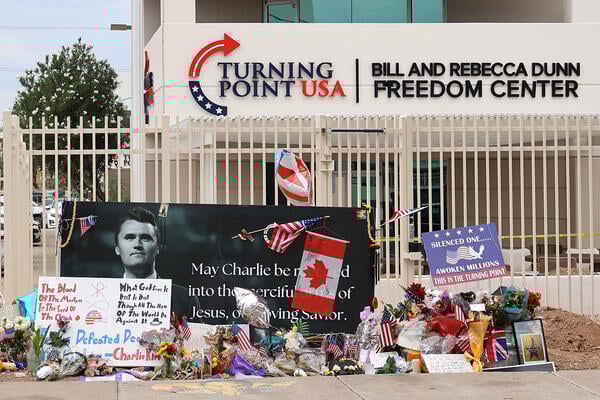
As of last week, a makeshift memorial to Kirk outside the gates of Turning Point’s headquarters in Phoenix was still attracting a steady trickle of mourners paying homage with flowers, flags, prayer candles and a Make America Great Again hat. Meanwhile, some conservative college students, politicians and media pundits are already rushing to fill Kirk’s role as the silver-tongued provocateur of campus liberals who proved instrumental in rallying college students to vote for Trump last year.
I wouldn’t be surprised if Turning Point USA as it exists right now fades a little bit because there is no Charlie Kirk replacing it, but I still don’t think the movement itself is dead.”
—Lauren Lassabe Shepherd, author of Resistance From the Right: Conservatives and the Campus Wars
But experts on conservative campus movements believe anointing a new figurehead isn’t necessary for Turning Point to sustain its mission of elevating right-wing ideology in higher education, which is also a core focus for the Trump administration.
“I wouldn’t be surprised if Turning Point USA as it exists right now fades a little bit because there is no Charlie Kirk replacing it, but I still don’t think the movement itself is dead,” said Lauren Lassabe Shepherd, a community scholar affiliate at Indiana University and author of Resistance From the Right: Conservatives and the Campus Wars. “Even if Turning Point is no longer the vehicle for the right to take over campuses, Donald Trump is still dismantling the Education Department and withholding millions from universities. There will be something else to fill that void.”
As of now, however, Turning Point still has the political, social and financial capital to mold the next generation of conservative leaders and voters on college campuses.
Reaching More Students
For Morales and other conservative Christian college students who believe, as Kirk did, that their views—including distaste for undocumented immigration, abortion and gender fluidity—aren’t well represented or tolerated on campus, Turning Point’s official nonprofit, nonpartisan status presents an opportunity to reach more students.
“Democrats obviously know that the College Republicans aren’t a club that represents their values,” said Morales, who characterized Vanderbilt’s campus climate as “polarized.”
“But having Turning Point on campus can bring members from both our Republican and Democrat clubs together to host events and have guest speakers from both sides … Being able to talk about hot topics freely and respectfully is going to help Vanderbilt’s environment for all students.”
Open debate may be a goal for the new generation of college students leading Turning Point chapters. But Kirk’s signature “prove me wrong” events were less about free expression and more about making extremist views held by the alt-right of the mid-2010s more palatable to a broader swath of college students and social media followers, said Daniel Martinez HoSang, a professor of American studies and political science at Yale University who has studied Turning Point.
“A lot of students in those spaces may not identify as a conservative, but Turning Point has made it fun, interesting, compelling and culturally relevant, and they’re providing all of these inroads to conservatism,” he said. “Framing his arguments around these [so-called] unthinking, dogmatic authoritarian liberals who can’t even answer a simple question about the meaning of gender allowed people to feel like [Kirk was] making some good points. It doesn’t require someone to say they want to exclude and discriminate against people. He shifted the focus from just demonizing people to ridiculing institutions.”
Kirk’s approach also set Turning Point apart from—and made it more popular than—older, more traditional conservative campus groups, such as the College Republicans and Young Americans for Freedom (now known as Young America’s Foundation.)
The latter organizations are geared toward “students who are interested in conservative policy work and conservative texts and ideas around the marketplace, taxes and services. They create a pipeline into an existing network of conservative organizations like the Heritage Foundation or the Cato Institute,” HoSang said. “Think here of the young sport-coat-and-tie-wearing types,” he added, referencing Mitt Romney, Dick Cheney and Alex P. Keaton, the fictional Family Ties son who became a poster child for young conservatism in the 1980s. “Turning Point really set that aside. That’s not their pipeline. They didn’t want smarty-pants policy folks; they wanted people.”
The jeans and T-shirt ensemble Kirk was wearing when an assassin shot him at Utah Valley University Sept. 10 had become his campus uniform, which supported Turning Point’s proposition to make conservatism “feel insurgent, fun and rebellious, which was such a switch from the older versions of conservatism that represented the establishment,” HoSang said. “Turning Point’s sense was that progressives and liberals have much more cultural authority, especially over young people’s view of the world, and that’s where they intervened.”
Now that we’ve had this tragic assassination and the opportunity to bring a Turning Point chapter to the community, this is our chance to boost what we do as Misericordia College Republicans and give us some national recognition.”
—Ryan DeBellis, vice president of Misericordia College Republicans
And it worked. At the time of Kirk’s death, Turning Point had more than 800 chapters at colleges and universities and was actively working on starting more, sending activism kits to campuses across the country.
The College Republicans at Misericordia University, a small Catholic institution in Pennsylvania, received one of those kits a couple of years ago. But it wasn’t until after Kirk’s death that Misericordia students applied to start an official Turning Point chapter, which typically has more resources and a broader reach than College Republicans.
“This is a literal turning point in America,” said Ryan DeBellis, a business administration major and vice president of the Misericordia College Republicans. “Now that we’ve had this tragic assassination and the opportunity to bring a Turning Point chapter to the community, this is our chance to boost what we do as Misericordia College Republicans and give us some national recognition.”
DeBellis, who said Republican messaging about work ethic resonates with his blue-collar upbringing, also hopes that having a Turning Point chapter will foster more constructive conversation between the left and the right on campus; he believes his college has gone too far in its embrace of diversity to the point that “it’s tearing us apart,” citing a campus drag show as an example.
Some Fear Danger
Although he said more students have expressed interest in joining the College Republicans since Kirk’s assassination, DeBellis has also heard from some students and faculty who are opposed to launching a Turning Point chapter at Misericordia. One of their concerns is Turning Point’s infamous Professor Watchlist, a registry of faculty accused of liberal bias and “anti-American values” that has led to some receiving death threats. In 2023, two Turning Point workers assaulted a queer professor at Arizona State University.
DeBellis agrees Misericordia doesn’t need a professor watchlist, and he’s still trying to clarify with Turning Point if the watch list is a requirement for a campus chapter.
“We have good professors here—we have no use for that,” he said. “It could promote potential violence. It would be a shame if a professor had to fear for their safety because they find out they’re blasted on Professor Watchlist.”
But similar concerns didn’t stop the University of Tennessee at Chattanooga from approving a new Turning Point chapter last week, despite the student government association’s recommendation to reject its application.
Kenyan King, a student senator who voted against Turning Point, said that while he supports the constitutional right to free expression, his decision “was about fostering respect, curiosity and safety, not ideology,” reported The Chattanooga Times Free Press. “Turning Point USA has a national track record of harassment, misinformation and intimidation,” King said. “Recognizing a chapter here would not advance discourse in any capacity—it would endanger.”
Future of the Brand
Regardless of how many new campus chapters crop up, it’s hard to know whether Kirk’s trademark campus debate events will persist. Turning Point did not respond to Inside Higher Ed’s multiple requests for comment about its future.
But finding someone who can master or mimic Kirk’s style isn’t a must for the organization to carry on after Kirk’s death, said Matthew Boedy, an associate professor of English at the University of Northern Georgia who just published a book about how Kirk’s brand of Christian nationalism is a threat to democracy.

Chip Somodevilla/Getty Images
“The debate things are kind of getting old. There’s only so many videos you can show of people getting burned or embarrassed—and Charlie was the best at it. They don’t need a figurehead, they need events that help the brand,” said Boedy, who has been on Turning Point’s professor watch list for years. “That brand is full of grievances and negativity toward higher education, and that will continue with whatever events they have.”
By contrast, many of the conservative students who are now part of Turning Point perceive the group to be a beacon of civil discourse. And that’s the vision they want to advance in Kirk’s absence.
“I want to see more unity and less political polarization,” said Clarabelle Ramsey, president of the newly reactivated Turning Point chapter at Casper College in Wyoming. “After his death, all of us as chapters realized that we can take up a lot of the work Charlie was trying to do.”
Source link

You may also like


Around The Web In ESL/EFL/ELL