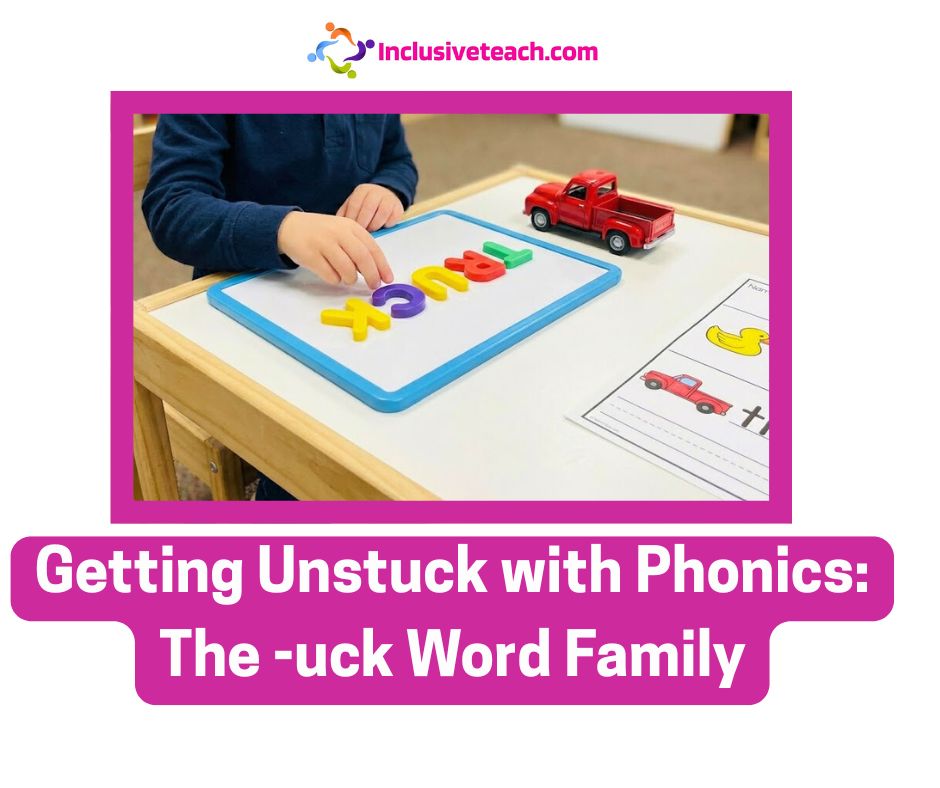
Getting Unstuck with Phonics: The -uck Word Family
The -uck Word Family Word Lists
There is something incredibly satisfying about the “-uck” word family. It is punchy. It is percussive. And, let’s be honest, it is a favorite among kids because it rhymes with… well, let’s just say it rhymes with a lot of words they find hilarious. But here is the thing: this word family is actually a goldmine for early reading. It is consistent, it follows a clear rule, and it bridges the gap between simple alphabet sounds and real, confident reading.
If you are a parent trying to get your child to look at a page without melting down, or a teacher looking for a fresh angle, this guide is for you. We aren’t going to complicate this. We are going to look at why these words work, list them out so you don’t have to guess, and give you some messy, hands-on ways to teach them.

Why the -uck Family Matters
The “-uck” family is what we call a “rime.” It consists of a short vowel (u) followed by a digraph (ck). A digraph is just a fancy teacher term for “two letters that make one sound.”
When you teach this, you are actually teaching a very important phonics rule. We use “ck” at the end of a one-syllable word right after a short vowel. We don’t use “k” and we don’t use “c” by themselves. We use the “ck” pair to protect that short vowel sound. Once a child gets that pattern, they can suddenly read twenty new words. It builds confidence fast.
The Ultimate -uck Word List
We are going to break this down by size. You shouldn’t just throw a list of 50 words at a kid; that is a recipe for disaster. Start small. Once they master the four-letter words, you move up.
Level 1: The Essentials (4-Letter -uck Words)
These are your bread and butter. These words follow a simple pattern: one consonant sound, followed by the “-uck” ending.
| Word | Simple Definition |
| Buck | A male deer, rabbit, or goat. |
| Duck | A swimming bird with webbed feet and a flat bill. |
| Huck | To throw or toss something. |
| Luck | Good or bad things that happen by chance. |
| Muck | Wet dirt, mud, or waste matter. |
| Puck | A hard rubber disc used in ice hockey. |
| Suck | To pull something into the mouth. |
| Tuck | To push loose edges of clothes or sheets in to make them tidy. |
| Yuck | A sound you make when something tastes or smells bad. |

Teaching Tip: Focus on “Duck” and “Truck” first. They are the easiest to picture. Use “Yuck” when you are eating vegetables; they will remember that one instantly.
Level 2: The Next Step (5-Letter -uck Words)
Once your learner is confident with the list above, you add a challenge. These words introduce “blends.” This is where two consonants start the word, like the “cl” in “cluck.” You hear both sounds, but they blend together.
| Word | Simple Definition |
| Chuck | To throw something carelessly; also a nickname for Charles. |
| Cluck | The sound a chicken makes. |
| Pluck | To pull something out quickly (like a feather). |
| Shuck | To remove the outer cover from corn or oysters. |
| Snuck | To move secretly without being seen (past tense of sneak). |
| Stuck | Caught in one place and unable to move. |
| Truck | A large motor vehicle used for carrying heavy loads. |
Teaching Tip: Watch out for “Truck.” The “tr” blend is tricky. Children often hear “ch” and try to write “chruck.” Stretch the sound out for them: Tttttt-rrrrr-uck.
Level 3: The Challenge Round (6+ Letters & Compounds -uck words)
These are excellent for advanced readers or older students who need to work on multi-syllable words. Many of these are compound words, which are just two small words glued together.
| Word | Simple Definition |
| Struck | To hit something with force (past tense of strike). |
| Canuck | A slang term for a Canadian person. |
| Potluck | A meal where every guest brings a different dish to share. |
| Unstuck | To free something that was fixed or caught. |
| Moonstruck | Behaving strangely because you are in love. |
| Starstruck | Feeling amazed or shy because you met a famous person. |
| Woodchuck | A chunky, burrowing animal; also called a groundhog. |
| Dumbstruck | So shocked or surprised that you cannot speak. |
| Firetruck | A large truck equipped to put out fires. |
| Thunderstruck | Extremely surprised or shocked. |
Sensory & Fun Activities Using our -Uck Words
You can have the best list in the world, but if you just put it on a piece of paper, you might lose them. Especially if you have neurodiverse kids, sitting still and drilling flashcards is often a no-go. You have to get the body involved.
Here are three activities that work.
1. The “Muck” Bin Word Hunt
This is hands-down the most popular activity, though it requires a little cleanup. We are playing on the word “muck.”
- The Setup: Get a plastic bin. Fill it with something sensory. If you are brave, make chocolate pudding or mix cornstarch and water (oobleck). If you want less mess, use kinetic sand, dried black beans, or even shredded brown paper.
- The Prep: Write your “-uck” words on laminated cards. Or, get small objects: a toy truck, a rubber duck, a hockey puck, a plastic deer (buck).
- The Activity: Bury the items in the “muck.” Have your child dig in with their hands to find them.
- The Learning: When they pull an item out, they have to shout the word. If they pull out a card, they read it. If they pull out an object, they have to spell it.
- Why it works: The sensory input calms the nervous system. It makes the brain more receptive to learning. They aren’t “studying”; they are digging for treasure.

2. Duck, Duck, TRUCK!
This is a twist on the classic “Duck, Duck, Goose” game. It gets the heart rate up.
- The Setup: Sit in a circle (or just you and the child facing each other).
- The Play: Instead of saying “Goose,” the person walking around the circle holds a flashcard with a word on it.
- The Twist: They tap heads saying “Duck… Duck… Duck…” When they drop the card in someone’s lap, that person has to read the word on the card (e.g., “PLUCK!”) before they can chase the runner.
- Why it works: It connects reading speed with physical reaction time. It keeps them alert.
3. The “Stuck” Truck
This is great for fine motor skills.
- The Setup: Draw a big picture of a truck on a piece of paper. Put some double-sided tape or “sticky tack” all over the truck.
- The Play: Give the child small pieces of paper with letters on them.
- The Task: Tell them, “Oh no! The letters are stuck on the truck! We need to make words to get them off.” Call out a word like “LUCK.” The child has to find L-U-C-K and stick them onto the truck in order.
- Why it works: It breaks the word down into individual sounds (segmenting) and then puts them back together (blending).
Troubleshooting: Common Sticking Points
Sometimes, it just doesn’t click. That is okay. If your child is reading “duck” as “duk” (short vowel sound issues):
Go back to the vowel. Make sure they know the “u” sound (like getting punched in the stomach—”uh!”). Practice just the “u” sound before adding the “ck.” If your child is mixing up “d” and “b” (reading “buck” as “duck”):
This is classic. Do not panic. It is not necessarily dyslexia; it is often just developmental. Give them a visual cue. Teach them the “bed” trick with their hands to distinguish the letters.
Conclusion
Teaching the “-uck” family doesn’t have to be a chore. It is one of the most reliable, consistent patterns in English. Once your child masters it, they have access to dozens of new words. They can read about trucks stuck in the muck. They can read about ducks with bad luck.
Start with the four-letter list. Get your hands dirty in the sensory bin. Keep it light. Keep it fun. And remember; if they get stuck, just take a break. You can always try again tomorrow.
Related
Discover more from Special Education and Inclusive Learning
Subscribe to get the latest posts sent to your email.
Source link

You may also like
The Ultimate Guide to the -CK Word Family
Comprehensive Word List for Teachers