Educational institutions in Karnataka get 6 months to enforce mental health norms, ETEducation
Bengaluru: Karnataka govt has issued a circular to all schools, colleges, universities, and coaching centres mandating the adoption and implementation of the Supreme Court’s order to enforce uniform mental health guidelines in educational institutions.
The state govt has directed all educational institutions to implement these guidelines within the next six months or by the start of the next academic year, whichever comes first.
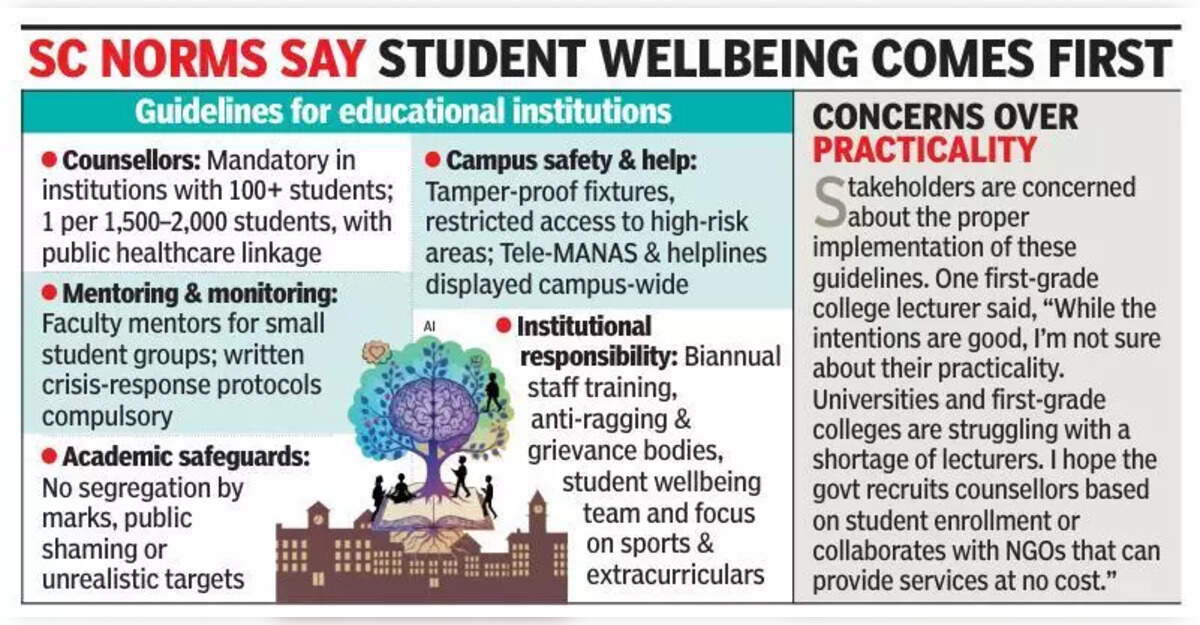
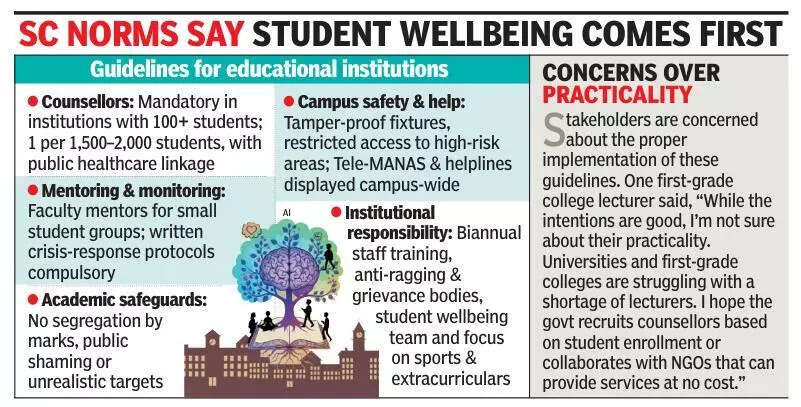
In July, the Supreme Court established a 15-point guideline for educational institutions nationwide following a series of reported suicides on campuses. According to these guidelines, all institutions with 100 or more enrolled students must appoint at least one qualified counsellor, psychologist, or social worker with training in child and adolescent mental health.
Institutions should maintain a minimum ratio of one counsellor for every 1,500 to 2,000 students and establish formal connections with public healthcare institutions.
Additionally, faculty mentors should be assigned to smaller groups of students, particularly during examination periods and academic transitions, to provide consistent, informal, and confidential support.
The guidelines recommend that institutions refrain from segregating students based on academic performance, from public shaming, and from assigning academic targets that are disproportionate to students’ abilities — practices common in institutions focused on entrance examinations.
Schools and colleges, including residential campuses, are required to implement safety measures such as installing tamper-proof ceiling fans and other safety devices. They must also limit access to unsafe materials and high-risk areas, such as rooftops and balconies, to prevent impulsive acts of self-harm.
Institutions must create written protocols for supporting students in high distress or suicidal crises. Suicide helpline numbers, including Tele-MANAS and other national services, should be prominently displayed in hostels, classrooms, and common areas.
All teaching and non-teaching staff are required to participate in mandatory orientation sessions at least twice a year, conducted by certified mental health professionals. These sessions will cover psychological first aid, identification of warning signs, responses to self-harm, and suicide-risk management.
Furthermore, all educational institutions must establish anti-ragging cells, internal complaints committees for addressing sexual harassment, and student grievance redressal committees. They are also required to form a Student Wellbeing Team (SWT) comprising counsellors, trained faculty, students, and parents to promote awareness of mental health.
Lastly, the guidelines emphasise the importance of extracurricular activities, directing institutions to utilise scheduled physical education periods exclusively for sports and fitness.
BOX: Concerns over feasibility
Stakeholders are concerned about the proper implementation of these guidelines. One first-grade college lecturer said, “While the intentions are good, I’m not sure about their practicality. Universities and first-grade colleges are struggling with a shortage of lecturers. I hope the govt recruits counsellors based on student enrollment or collaborates with NGOs that can provide services at no cost.”

Source link