ED Panel Signs Off on New Earnings Test
The revamped proposal could cut failing programs off from federal student aid entirely.
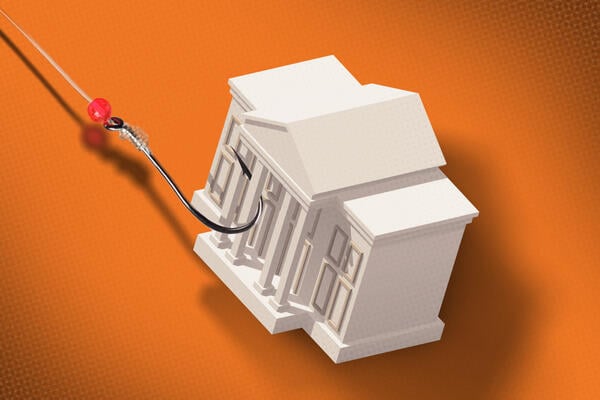
Photo illustration by Justin Morrison/Inside Higher Ed | skodonnell/E+/Getty Images | tarras79/iStock/Getty Images
After a week of talks and a final compromise from the Education Department, an advisory committee on Friday signed off on regulations that would require all postsecondary programs to pass a single earnings test.
The new accountability metric, set to take effect in July, could eventually cut failing programs off from all federal student aid funds—an enhanced penalty that appeared key to the committee reaching consensus Friday. Before the compromise, programs that fail the earnings test would only have lost access to federal student loans. Under the proposal, college programs will have to show that their graduates earn more than a working adult with only a high school diploma.
In the course of negotiations, committee members repeatedly argued that allowing failing programs to receive the Pell Grant didn’t sufficiently protect students or taxpayer funds, and it appeared unlikely that without more significant changes, the committee would reach unanimous agreement.
But now, failing programs will also lose eligibility for the Pell Grant if their institution doesn’t pass a separate test, which measures whether failing programs account for either half of the institution’s students or federal student aid funds. If either condition is met in two consecutive years, the programs will be cut off. The timing of the two tests and consequences mean that it will take at least three years for institutions to lose all access to federal student aid. Individual programs lose access to loans after failing the earnings test in two consecutive years.
Preston Cooper, the committee member representing taxpayers and the public interest, who had opposed the department’s initial proposal, said the agency’s compromise would “protect a lot of students.”
“By some of our calculations here, this would protect around 2 percent of students and close to a billion dollars a year in Pell Grant funds,” he said.
The department unveiled this new penalty late Friday morning after what ED’s lead negotiator Dave Musser called an “extremely productive” closed-door meeting with nearly all of the committee members. The proposed regulations aren’t yet final. The department is required to release them for public comment and review that feedback before issuing a final rule.
Other committee members also praised the compromise as “reasonable’ and “common-sense.” Members representing states and accreditors said the revised earnings test and new penalties would help to ensure institutions offer credentials that boost graduates’ earnings. Some suggested that the accountability framework could better inform discussions between institutions and employers, as it sets clear standards.
“And those standards are going to influence the decisions that [employers] make, and that’s going to be a pretty large educational effort,” said Randy Stamper with the Virginia Community College System, who represented states on the committee. “But at least we have the tool to hang our hat on to make points that low-earning programs are a result of low pay, and I think that will help us.”
How Courses Will Be Measured
The department’s proposal essentially combines two accountability metrics—the Do No Harm standard that Congress passed last summer and the existing gainful-employment rule. Gainful employment only applies to certificate programs and for-profit institutions, whereas Do No Harm covers all programs except certificates.
Tamar Hoffman, the committee member representing legal aid, consumer protection and civil rights groups, was the only person to abstain from voting. (Abstaining doesn’t block consensus.)
“The reason I’m abstaining from this vote is because it was made very clear to me throughout this process that protections for students in certificate programs would be taken away altogether if I blocked consensus, and those students are just too important for me to take that risk, especially with the long history of abuse in certificate programs,” Hoffman said.
About 6 percent of all programs would fail the combined earnings test, including about 29 percent of undergraduate certificates, according to department data. Roughly 650,000 students were enrolled in a failing program as of the 2024–25 academic year, half of whom attend a for-profit institution.
“Proprietary institutions are eager to be able to demonstrate where we have programs that are of great value and have good outcomes,” said Jeff Arthur, the committee member representing the for-profit higher education sector. “We’re looking forward to having that opportunity to have a level comparison for the first time across several metrics with all other programs.”
Education Under Secretary Nicholas Kent praised the committee’s work in his closing remarks, saying they made history by adopting a standard accountability metric that will ensure the taxpayer investment in higher education is working for everyone.
“For years, we have been bogged down in ineffective measures that simply failed to capture the full picture of how all programs were actually performing,” he said. “This new framework is different. It’s about ensuring that all programs meet a baseline for financial value, a baseline that reflects the needs of students and taxpayers alike.”
What’s Next for OBBBA Regulations
Friday’s meeting ends two rounds of negotiations at the Education Department to implement Congress’s One Big Beautiful Bill Act. In November, a different advisory committee reached consensus on regulations related to repayment plans, graduate student loan caps and what’s become a controversial plan to designate 11 degree programs as eligible for a higher borrowing limit. Then, in December, this advisory committee approved rules to expand the Pell Grant to short-term workforce training programs.
The department still has to take public comments and finalize those rules before July 1. Kent said the regulations for the student loan provisions should be published later this month.
Several outside policy experts doubted whether the department could get through the necessary negotiations and reach consensus on all the topics—a point that Kent addressed as he called out some of the media coverage surrounding the talks.
“And yet, here we are today,” he said. “Together, we have built something that will stand the test of time and end the regulatory whiplash. Once again, those who bet against us were wrong. They continue to severely underestimate this administration and this committee.”
Source link

You may also like

GeoGallery Looks Like A Fun Art AND Geography Game