Bring Writing To Life: Banning Dead Words
The “Dead Words” List: Burying Boring Vocabulary and Bringing Writing to Life
Nothing kills a good story faster than boring words. Honestly, as a teacher, I see the same pattern over and over, especially around 3rd and 4th grade. A student has a brilliant idea for an adventure story. There are dragons! There are spaceships!
But when I read it, it sounds like this:
“Look at the dragon,” he said. “It is big,” she said. “That is good,” he said. Then they went home.
It falls completely flat.
In the classroom, we call these repetitive, overused vocabulary words “Dead Words.” They have been used so many times that they have lost all their life and energy. They don’t paint a picture. They don’t show emotion. For my students with special needs, especially those who struggle with social cues or emotional literacy, relying on dead words is a major trap. The word “said” gives no clue as to whether a character is angry, sad, excited, or terrified.
If we want our kids to write better, we need to help them hold a funeral for these boring words and introduce them to lively new alternatives. Here is your guide to the most common writing traps and the vibrant vocabulary that can replace them.
The Activity: Holding a “Word Funeral”
Before we get to the lists, make it fun. Kids love a little drama.
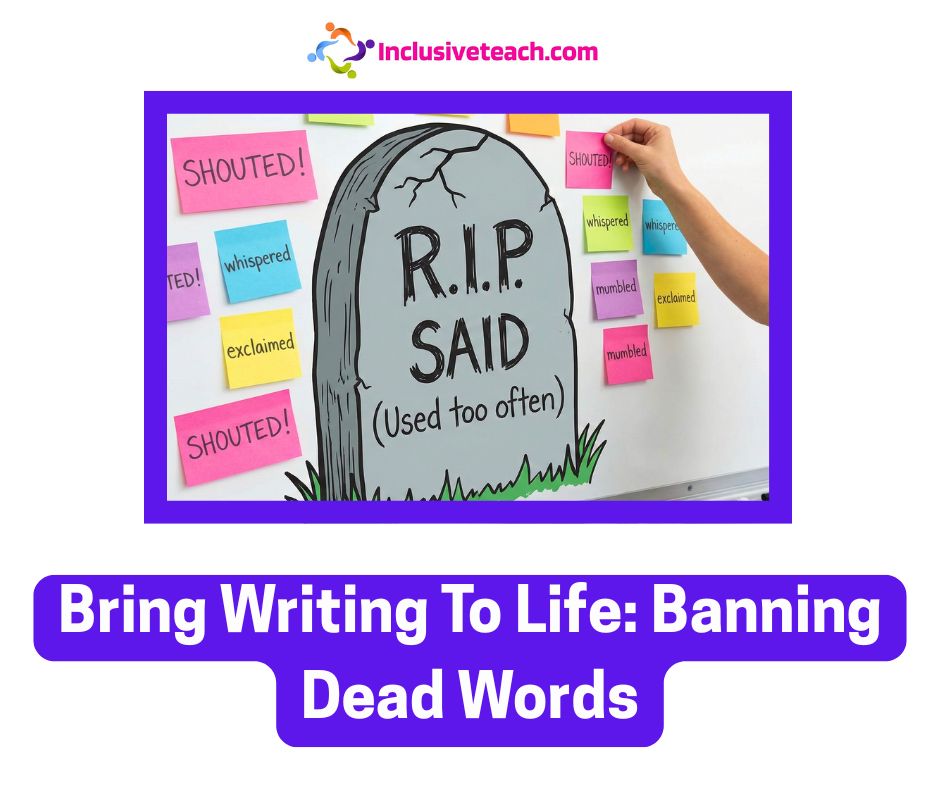
When I introduce this concept, I literally draw a tombstone on the whiteboard. I tell the class, “Today is a sad day. We are saying goodbye to our old friend, ‘SAID’. He has worked very hard, but he is tired. May he rest in peace.”
We then brainstorm better words to take his place. This makes the abstract concept of “improving vocabulary” concrete and memorable.

Dead Word List #1: SAID (The Biggest Offender)
This is the number one culprit in boring dialogue. I do not recommend giving students an alphabetical list of synonyms for “said.” That is overwhelming. Instead, group them by volume and emotion.
For visual learners, as many children with SEN are, I create a “Volume Thermometer.” Quiet words are at the bottom in blue; loud words are at the top in red.
Quiet Words (Instead of whispering)
- Mumbled
- Murmured
- Whispered
- Breathed
- Hissed (Great for angry villains!)
Loud Words (Instead of yelling)
- Shouted
- Yelled
- Screamed
- Bellowed
- Roared (Perfect for monsters or angry dads)
Happy/Excited Words
- Cheered
- Exclaimed
- Giggled
- Joked
Sad/Angry Words
- Cried
- Sobbed
- Groaned
- Grumbled
- Snapped
Question/Answer Words
- Asked
- Inquired
- Replied
- Answered

Dead Words #2 and #3: GOOD and BAD (The Bland Twins)
These words are lazy. They give an opinion without giving any detail.
- “The movie was good.” (Was it funny? Scary? Action-packed?)
- “The lunch was bad.” (Was it gross? Cold? Burnt?)
We need to teach kids to be specific about what made it good or bad.
Instead of “GOOD”:
- For food: Delicious, tasty, yummy.
- For fun times: Exciting, enjoyable, fantastic, awesome.
- For behavior: Polite, helpful, kind.
- For skills: Talented, skilled, expert.
Instead of “BAD”:
- For food: Gross, disgusting, awful.
- For scary things: Terrifying, horrible, dreadful.
- For behavior: Rude, mean, naughty.
- For mistakes: Incorrect, wrong.
Dead Word #4: WENT (The Boring Action)
“Went” is the most boring verb in the world. It tells us movement happened, but not how.
If a character is scared, they don’t just “go” away; they run or flee. If they are tired, they trudge.
Fast Movement
- Ran
- Raced
- Dashed
- Sprinted
- Flew
Slow/Quiet Movement
- Walked
- Crept
- Tiptoed
- Trudged (walking heavily, like through snow or mud)
- Strolled (walking happily and slowly)
How to Use This at Home: “Word Surgery”
You don’t need a classroom to fix dead words. You can do “Word Surgery” on your child’s homework.
- Have your child write their story draft.
- Give them a highlighter.
- Ask them to highlight every “dead word” they can find. (They usually find five or six “saids” on one page).
- Together, use these lists to “operate” on the story. Cross out the dead word and write a lively, healthy new word above it.
Alt Text: A child editing their handwriting story, crossing out boring words and replacing them with descriptive vocabulary using a red pen and a thesaurus.
Final Thoughts
Changing vocabulary isn’t just about making a story sound fancy. It is about helping children understand their own world better.
When a child learns the difference between “said” and “mumbled,” they are learning about human emotion. When they learn the difference between “ran” and “trudged,” they are learning about body language.
It takes time, so be patient. Start by banning just one word a week. This week: No more “said.” Next week: Goodbye “went.”
Before you know it, their writing will come alive.
Related
Discover more from Special Education and Inclusive Learning
Subscribe to get the latest posts sent to your email.
Source link

You may also like

Understanding the Concrete-Pictorial-Abstract (CPA) Approach
Words That Sound the Same: A Visual Homophone Guide