
Be The Voice In Learning Tech
Thought Leadership Marketing: Becoming The Voice In Learning Tech
Learning tech markets are more crowded than ever. LMS platforms, LXP solutions, AI learning tools, and HR tech vendors all compete with similar feature sets, similar promises, and increasingly similar messaging. From the buyer’s perspective, differentiation has become harder, not easier.
At the same time, learning technology buyers are under pressure. Budgets are scrutinized. Buying committees are larger. Risk tolerance is lower. Decisions that once involved a single L&D leader now require alignment across HR, IT, compliance, procurement, and executive leadership. In this environment, vendors are not evaluated only on functionality; they are evaluated on credibility.
This is where thought leadership marketing becomes a strategic advantage rather than a branding exercise.
The learning tech companies that win trust, consideration, and long-term growth are not simply the most visible. They are the ones that consistently help the market make sense of complexity. Hence, they tend to shape how potential buyers think about problems, trade-offs, and future direction way before they make a purchasing decision.
In this article, we break down how learning tech companies become go-to voices instead of just visible vendors in the market. Moreover, we explain what thought leadership marketing really is, why it matters more in learning and HR tech than in many other B2B categories, and how you can build authority through insight, consistency, and credibility, not content volume or promotion.
Thought leadership marketing works when companies consistently shape how a market thinks, not when they simply promote what they sell.
- Thought leadership marketing builds trust long before buyers are ready to buy.
- The strongest learning tech brands lead conversations, not campaigns.
- Authority comes from insight, consistency, and credibility, not volume.
- Becoming the go-to voice requires strategic focus, not more content.
Do you want to turn thought leadership into category authority?
Team up with eLearning Industry to amplify your expertise in a trusted industry context.
Why Thought Leadership Matters More In Learning Tech
It is true that learning technology is a high-consideration, high-risk B2B category. Unlike impulse SaaS purchases, LMS and HR tech decisions affect strong areas like compliance, workforce performance, and long-term organizational capability. As a result, buyers are hesitant to commit at first and behave cautiously.
There are several structural realities that make thought leadership especially critical in the business growth strategies of companies in the learning tech market.
- Feature parity across platforms: Anyone looking in the market can see that the majority of LMS and HR tech solutions offer similar core functionality. Therefore, feature checklists rarely create meaningful differentiation.
- Long sales cycles: Due to the structure of the companies, enterprise and mid-market deals often span months, not weeks.
- Large buying committees: Since there are multiple parties involved in the buying decision, it is difficult to satisfy them all. HR, L&D, IT, procurement, security, and leadership all influence the buying decision.
- Risk-averse buyers: Some buyers are hesitant to commit due to the risks of switching platforms, underscoring the importance of trust.
- Strategic impact: Purchasing an LMS should not be considered as software usage. Instead, it has a strategic impact on a company since it influences skills, compliance, onboarding, and culture.
In this context, buyers don’t just buy products. They buy confidence. Confidence that a vendor understands their challenges, that the platform will scale, and that the company will still be relevant years from now.
Thought leadership marketing provides that confidence by helping in a company’s brand positioning strategy as a trusted guide, not just a solution provider.
What Thought Leadership Marketing Really Is (And What It Is Not)
Before going further, it’s important to clarify what thought leadership marketing actually means and what it does not. Confusion at this level is one of the main reasons many efforts fail.
Thought leadership marketing is:
- Perspective-driven. It provides a clear understanding of industry challenges, trends, and decisions.
- Insight-led. It is grounded in experience, data, and pattern recognition.
- Market-shaping. It shapes the market by influencing how buyers frame problems and evaluate options.
- Strategic. It supports long-term positioning, not short-term promotion.
Thought leadership marketing is not:
- Product promotion disguised as insight.
- Content volume or publishing frequency.
- Opinion without substance.
- Personal branding disconnected from company strategy.
In learning tech, effective thought leadership helps buyers navigate uncertainty. It explains not just what is changing, but why it matters and how leaders should think about it.
Thought Leadership Vs. Content Marketing
A common mistake in marketing is to treat thought leadership marketing and content marketing as interchangeable. Experienced professionals in the area understand that, strategically, they serve very different purposes.
In a nutshell:
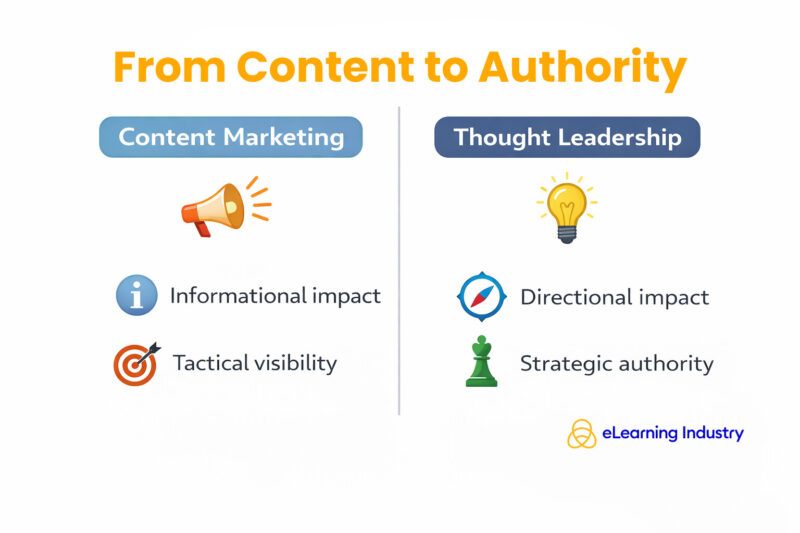
- Content marketing informs.
- Thought leadership influences.
- Content answers existing questions.
- Thought leadership reframes the questions buyers ask in the first place.
- Content supports tactical visibility.
- Thought leadership builds strategic authority.
Both matter, sure, but only one positions a company as a category voice.
Thought leadership marketing shapes narratives around learning strategy, workforce transformation, AI adoption, compliance, and skills development. It influences perception before buyers ever compare vendors.
How Companies Become The Go-To Voice In Learning Tech
It is not a simple journey to become a trusted authority in the learning tech market. That is because, to do so, you should not focus solely on volume, visibility, or self-promotion. Instead, it is about consistently shaping how the market thinks about challenges, decisions, and the future direction of the market.
A common theme across learning and HR tech is that companies that emerge as category voices share five consistent behaviors.
1. They Take A Clear Point Of View
Thought leadership requires conviction and a strong voice. The strongest learning tech voices are willing to take positions on:
- The future of workplace learning.
- The role of AI in skills development.
- The limitations of legacy LMS models.
- The trade-offs between compliance, engagement, and personalization.
They don’t hedge every statement. They don’t try to please everyone. Instead, they articulate how they believe the market should evolve and why.
All this clarity creates an important differentiation. It is true that even when buyers don’t fully agree, they remember who challenged their assumptions.
At the end of the day, consistency matters more than novelty. That is because authority is built when a company reinforces its core perspectives over time, not only when it chases trends in vanity.
2. They Focus On Market Problems, Not Products
It is vital to remember that thought leadership marketing is buyer-centric by design.
Therefore, instead of leading with:
- Feature updates.
- Platform capabilities.
- Roadmap announcements.
Go-to voices lead with:
- Buyer pain points.
- Organizational challenges.
- Strategic trade-offs.
- Industry-wide constraints.
In the learning tech market, this means addressing questions such as:
- How do enterprises balance compliance and engagement?
- Why do learning initiatives fail to drive behavior change?
- What does “skills-based learning” actually require at scale?
By focusing on problems the market recognizes, thought leaders earn relevance, even before buyers are evaluating solutions.
3. They Lead With Insight, Not Announcements
Valuable insight is what separates authority from noise. Therefore, insight-driven thought leadership includes:
- Analysis of why trends are happening.
- Interpretation of what changes mean for decision-makers.
- Context that connects isolated signals into a bigger picture.
In short, announcements describe what happened. Thought leadership explains why it matters.
In the learning tech market, this often takes the form of:
- Interpreting shifts in buyer behavior.
- Connecting regulatory changes to learning strategy.
- Explaining second-order effects of AI adoption.
Consequently, this kind of thinking is what positions a company as a guide, not a broadcaster.
4. They Show Pattern Recognition
The value of true thought leadership comes from pattern recognition, not isolated opinions. The fast-growing learning tech leaders draw insights from:
- Multiple customers across industries.
- Repeated challenges in enterprise rollouts.
- Trends emerging across regions and segments.
Moreover, they identify signals others miss:
- Why do certain LMS implementations stall?
- Where does learning investment consistently underperform?
- Which metrics actually correlate with impact?
In other words, pattern recognition reassures buyers that a company understands the market at scale, not just its own platform. That is why it is important to always focus on what is outside your own software.
5. They Build Authority Over Time
As per the definition, authority compounds.
Here, the truth is that trust is not built through one article, keynote, or campaign. It’s built through:
- Repetition of core ideas.
- Long-term presence in industry conversations.
- Consistent quality and perspective.
The secret to the success of learning tech companies is that they become reference points and do not disappear between launches. Instead, they show up when the market is confused, uncertain, or evolving to guide it.
Over time, buyers stop asking “Who is this?” and start asking “What do they think?”
Who Should Own Thought Leadership Inside Learning Tech Companies?
It is important to keep in mind the complexity and importance of thought leadership. Thought leadership is not a side project. It is a strategic marketing asset, and ownership matters.
The CEO As Vision Carrier
In the learning tech market, the CEO is not just the boss. Instead, the CEO embodies the long-term vision of the learning tech company. Here are some of the CEO thought leadership signals:
- Strategic confidence
- Market understanding
- Commitment beyond product cycles
You can see for yourself that when learning tech CEOs articulate how they see the future of learning, buyers always listen, especially at the enterprise level.
The CMO As Narrative Architect
The CMO’s role is critical in this area, as their mission is to translate vision into a coherent narrative with the following:
- Clarifying positioning.
- Ensuring consistency.
- Aligning insight with audience needs.
Note here that this is not just execution; it is perfect orchestration.
Leadership Team Alignment
Leadership is all about the team. The most credible thought leadership is not a single voice. It’s an aligned leadership team reinforcing shared ideas across product, sales, and brand strategy.
The goal is not individual visibility, but organizational authority.
Why Most Thought Leadership Efforts Fail
There are many pitfalls to avoid in leadership. From planning to execution, all are serious steps that require critical thinking and data-backed decision-making. It is a fact that in B2B companies, most leadership initiatives do not fail solely because of execution. Instead, they fail because of strategic misalignment.
Here are some of the most common reasons:
- Messaging is too generic to be remembered.
- Content focuses only on products instead of problems.
- Inconsistent points of view.
- No clearly defined audience.
- Short-term commitment, expecting immediate results.
As a result, without focus and patience, thought leadership becomes just another content stream, visible but not influential. That is why it is important to align thought leadership with other marketing efforts to not only promote your product but also a solution specifically designed for the audience you are targeting.
How Thought Leadership Shapes Buyer Decisions
In a competitive market like learning tech, buying decisions are rarely impulsive. Since most enterprises have multiple stakeholders, sales cycles are often long and difficult to complete. In general, the buying decisions often involve long sales cycles, multiple stakeholders, and significant perceived risk. In this scenario, thought leadership marketing plays a critical role before vendors are even shortlisted. The following are the benefits of utilizing thought leadership for your company.
It Reduces Perceived Risk
Large enterprises are not simple buyers with questions about the features of the software. Enterprise buyers don’t just ask, “Does this platform work?” They ask:
- Is this company credible?
- Do they understand organizations like ours?
- Will they still be relevant in three years?
In fact, thought leadership answers all these questions indirectly by demonstrating depth, perspective, and market awareness.
It Shortens Sales Cycles
It always helps to be familiar with the company you are going to collaborate with. This means that when buyers are already familiar with a company’s point of view, sales conversations start at a higher level. Less time is spent explaining fundamentals, and more time is spent validating the fit.
It Influences Buying Committees
Different stakeholders evaluate risk differently:
- L&D leaders look for learning impact.
- HR leaders look for scalability and governance.
- IT looks for stability and security.
Thought leadership that addresses these perspectives equips internal champions with the language and confidence to advocate internally.
It Builds Preference Before Evaluation
By the time buyers formally compare solutions, thought leadership has already shaped their expectations. Vendors perceived as category authorities are evaluated more favorably even before demos begin.
Thought Leadership As A Signal Of Market Leadership
Thought leadership is the key to creating a leader in the market. Especially in mature learning tech markets, leadership is signaled, not claimed. Therefore, a leader needs the proper signal in the market.
In this case, thought leadership marketing functions as a market signal where:
- Visibility suggests relevance.
- Insight suggests competence.
- Consistency suggests stability.
When thought leadership appears in trusted, contextual environments, it compounds credibility. So, when a market player emerges with thought leadership, potential buyers view them as an endorsement by association, not just another promotion.
Here is the key idea: authority is not created by reach alone—it is created by where and how insight appears.
This is exactly why trusted industry platforms like eLearning Industry play a critical role in building your thought leadership marketing. It is because context in a trusted platform amplifies credibility, and credibility accelerates trust, making your company a market leader.
How Thought Leadership Evolves As Companies Scale
As a practice, thought leadership is not stable. It is an entity that goes side-by-side with your company. An ongoing process that requires analysis and constant effort. On that note, thought leadership maturity evolves alongside company growth.
Emerging Voice
- Focus: Clarifying perspective.
- Goal: Being recognized as insightful.
- Risk: Blending into generic commentary.
Recognized Expert
- Focus: Consistent insight and interpretation.
- Goal: Being cited and referenced.
- Signal: Buyers seek your opinion.
Category Reference Point
- Focus: Shaping how others talk about the market.
- Goal: Defining narratives and standards.
- Signal: Competitors respond to your ideas.
The new shift is not about just producing more content. It’s more about owning ideas that the market returns to repeatedly.
Eager to get your thought leadership right and lead the market?
Reach out to our experts now and become the leader in your category.
Conclusion
In this article, we explored all aspects of thought leadership and its vital role in the learning tech market. It is a marketing technique that puts your company in the spotlight as a leader who inspires trust and credibility.
Regarding its practice, thought leadership marketing is not about saying more; it’s about saying what matters. Therefore, you should avoid generic messaging that targets all audiences. Instead, use specific messaging that addresses your audience’s problems, understands them, and offers the appropriate guided solution.
Especially in learning tech, authority determines:
- Who is trusted.
- Who gets shortlisted.
- Who shapes buying criteria.
Companies that lead conversations do not just compete in markets, they define them.
By committing to insight, clarity, and long-term presence, learning tech organizations move from being visible vendors to becoming the voices buyers rely on when decisions matter most.
FAQ
Thought leadership marketing is a strategic approach to building authority by shaping how a market thinks about key challenges, trends, and decisions.
Content marketing informs and educates, while thought leadership influences perception, direction, and decision-making.
Typically, the CEO or senior leadership team, supported by marketing as the narrative architect.
No. Effective thought leadership builds organizational authority, not individual visibility disconnected from strategy.
Thought leadership compounds over time. Impact grows through consistency, not short-term spikes.
It reduces perceived risk, builds trust, and helps buyers feel confident in complex, high-stakes decisions.
Yes. Authority comes from insight and clarity, not company size.
Not immediately. It influences consideration, preference, and deal velocity as a leading indicator of revenue.
In trusted, industry-specific environments where buyers already seek insight and validation.
Treating it as a campaign instead of a long-term strategic commitment.
Source link

You may also like

Employee Development Planning: A Strategic Guide

AI Trends In L&D For 2026: Architecting Human-AI Capabilities