Adjectives Ending in M
Adjectives Ending in M: The Teacher’s Guide
Let’s be honest with each other. When you are planning a unit on descriptive writing, the letter ‘M’ isn’t exactly the first place you look for inspiration. It doesn’t have the flashy suffixes of ‘L’ (magical, wonderful). It doesn’t have the punchy energy of ‘K’ (quick, dark).
If adjectives were staffroom biscuits, ‘M’ words would be the Rich Tea. Reliable. A bit plain. Easily overlooked when there’s a chocolate digestive on offer. We have links to our other “Adjectives ending in…” posts.
We spend so much time encouraging children to use “wow words”, those multisyllabic showstoppers that they love to sprinkle into sentences whether they fit or not. You know the ones. Where a Year 4 pupil describes their breakfast toast as “effervescent” because they found it in a thesaurus. But here is the thing. In our rush for complexity, we often skip over precision.
Adjectives ending in ‘M’ are mostly short, punchy, base words. Calm. Warm. Dim. Firm. They don’t rely on suffixes to do the heavy lifting. Because they are simple to spell, children often dismiss them as “baby words.”
Our job is to show them that these short words pack a serious punch when used correctly. Moving a child from describing a room as “dark” to describing it as “dim” changes the entire atmosphere of their writing. One is just lights out; the other implies mystery, softness, or perhaps a fading evening.
In this guide, we are going to give the letter ‘M’ the respect it deserves. We will look at why simple spelling doesn’t mean simple writing, provide the word lists you need, and I’ll share an “Attention Autism” inspired sensory activity that will help your class understand the true feeling of words like “calm” and “grim.”
Spelling ‘M’ Words: A Welcome Break
Good news. After the chaos of double ‘L’s and dropping ‘E’s in the previous article, you can breathe a sigh of relief.
Adjectives ending in ‘M’ are, phonetically speaking, exceedingly well-behaved.
They are almost entirely CVC (consonant-vowel-consonant) or CVCC words. They do exactly what it says on the tin.
- G-R-I-M.
- W-A-R-M.
- S-L-I-M.
There are very few hidden traps here. You don’t need to spend twenty minutes explaining a complex suffix rule that only applies half the time.
This is actually a massive pedagogical advantage. Because the spelling load is light, you can shift all that cognitive energy onto meaning and application.
When a child isn’t panicking about whether “solemn” has one ‘L’ or two (okay, that one is tricky, but it’s an outlier!), they have the brain scales free to think about when to use it. Use this to your advantage. These are great words for your lower-attaining spellers to master and feel confident using, while your greater depth readers can explore the complex atmospheres these simple words can create.

The Teacher’s Guide to Adjective Lists Ending in M
Since there are no suffixes to categorize by here, we are categorizing by meaning. These words are short, but they are mighty.
Category 1: Atmosphere and Senses
These words are brilliant for setting a scene without needing a paragraph of exposition.
- Dim: Not shining brightly; not clearly seen. (Much more atmospheric than just ‘dark’).
- Warm: At a comfortably high temperature; or, showing enthusiasm and affection. (Crucial double meaning).
- Calm: Not showing or feeling nervousness, anger, or other strong emotions. (A goal state for many classrooms!).
- Grim: Depressing or worrying to consider; uninviting. (A grim weather forecast; a grim expression).
- Glum: Looking or feeling dejected; morose. (Think Eeyore from Winnie the Pooh).
Category 2: Physical Description and State
Words that define the physical reality of something with precision.
- Slim: Gracefully thin; slender.
- Trim: Neat and smart in appearance; in good order.
- Firm: Having a solid, almost unyielding surface or structure. (Also applied to people: a firm teacher).
- Prim: Stiffly formal and respectable; feeling or showing disapproval of anything regarded as improper.
- Uniform: Remaining the same in all cases and at all times; unchanging in form or character.
Adjectives Ending in M by Length
Here is your quick-reference guide for differentiation. These are refined to be strictly adjectives—no nouns masquerading as descriptors.
3 Letter Adjectives Ending in M
- Dim: Not shining brightly; distinct.
- Grim: Depressing or worrying; uninviting.
4 Letter Adjectives Ending in M
- Calm: Not showing or feeling nervousness or anger.
- Firm: Having a solid, almost unyielding surface.
- Glam: (Informal) Glamorous.
- Glum: Looking or feeling dejected; morose.
- Prim: Stiffly formal and respectable.
- Slim: Gracefully thin.
- Trim: Neat and smart in appearance.
- Warm: Of or at a fairly or comfortably high temperature.
5 Letter Adjectives Ending in M
- Buxom: (Of a woman) plump, especially with large breasts. (Use with caution/older students).
- Glum: Looking or feeling dejected.
6 Letter Adjectives Ending in M
- Infirm: Not physically or mentally strong, especially through age or illness.
- Random: Made, done, happening, or chosen without method or conscious decision.
- Seldom: (Adverb/Adj) Not common; infrequent.
- Unwarm: Not warm. (Rare, but valid).
7 Letter Adjectives Ending in M
- Maximum: As great, high, or intense as possible or permitted.
- Minimum: The least or smallest amount or quantity possible.
- Optimum: Most conducive to a favorable outcome; best.
- Uniform: Remaining the same in all cases and at all times.
8+ Letter Adjectives Ending in M
- Lukewarm: (Of liquid or food) only moderately warm; tepid. (Also: showing little enthusiasm).
- Verbatim: In exactly the same words as were used originally.
The Classroom Activity: The Sensory “Calm Cave” (Attention Autism)
How do we teach these? If you just put the word “Grim” on the board and ask for a definition, you’ll get blank stares.
These are sensory words. They need to be felt.
We are going to use the Attention Autism structure again. It works because it bypasses the need for complex verbal processing upfront and hooks them in visually and kinaesthetically.
Theme: The Sensory Explorer.
Target Adjectives: Dim, warm, calm, firm, grim.
Prep: You need to create a small “den” area in your classroom. Throw a dark blanket over a table. Or just turn the main lights off and use torches. You want to change the atmosphere dramatically.
Stage 1: The Bucket (To Grab Attention)
As always, highly visual items in a bucket. Name them, show them, put them away.
- What’s in my bucket?
- I’ve got a… rock hard, firm stress ball. (Squeeze it, bang it on the table). Into the bucket.
- I’ve got a… pair of sunglasses for when it’s not dim. (Put them on coolly). Into the bucket.
- I’ve got a… lovely warm hot water bottle (or hand warmer packs). (Hug it, sigh dramatically). Into the bucket.
- Bucket time is finished.
Stage 2: The Attention Builder (The Main Event)
You are going to transform the space to demonstrate the adjectives.
- Action: Turn off the main classroom lights. Pull the blinds down.
- Narrate with ‘M’ words: “Oh wow. The classroom is changing. It isn’t bright anymore. It is getting dim. The light is low.”
- Action: Turn on a small, soft lamp or some fairy lights inside your ‘den’ area. Play some very quiet, gentle instrumental music.
- Narrate: “Listen. It is so quiet. It feels lovely and calm in here now. It’s a calm space.”
- Action: (Optional contrast). Hold up a picture of a storm or a really angry face.
- Narrate with a serious voice: “This is not calm. This looks grim. A grim storm.”
- Return to calm: Put the picture away. “Back to calm.”
Stage 3: Turn Taking (Shifting Attention)
Invite children up to interact with the sensory elements you’ve created.
- “James, come into the dim den. How does it feel?”
- “Sarah, here is the heat pack. Is it cold or is it warm?”
- “Leo, squeeze this ball. Is it squishy or is it firm?”
Keep the language focused on the target adjectives. Model the word every time they interact with the object.
Stage 4: Independent Work (Transitioning to Learning)
Bring the lights back up. The contrast will be jarring, which actually helps reinforce the concept of “dim” and “calm” they just experienced.
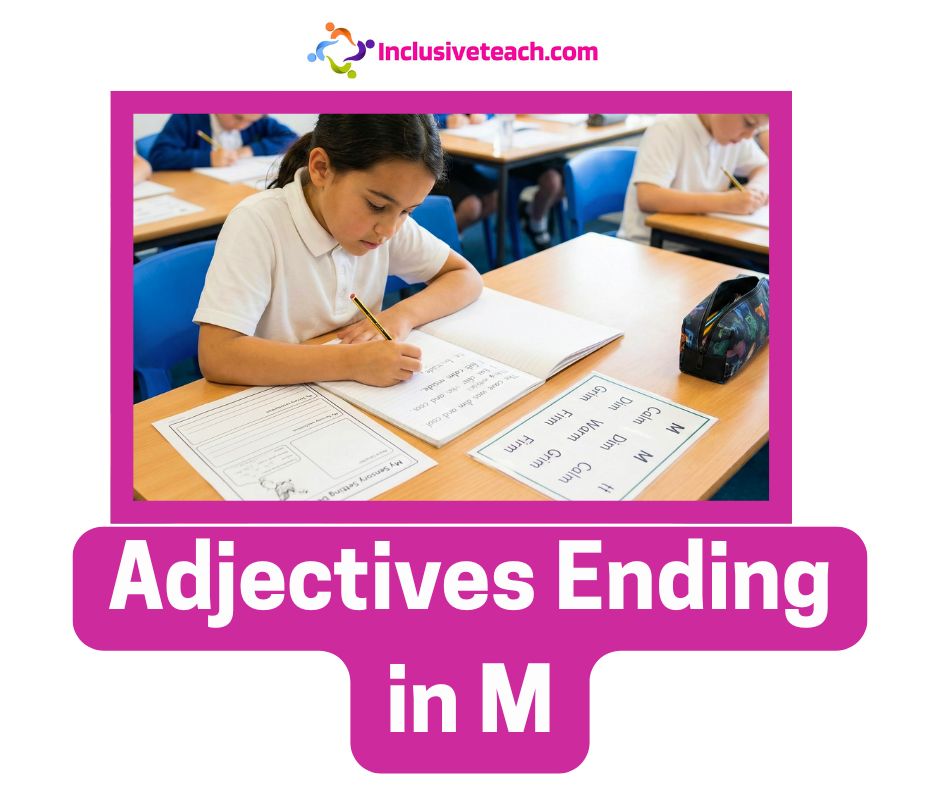
- The Task: Sensory Setting Description.
- The Writing: They need to write a short paragraph describing a place (a cave, a forest at night, their bedroom). They must use at least three of the ‘M’ adjectives to set the mood.
- Example (Lower KS2): “The bear’s cave was dim. It felt warm inside. The bear was calm and sleepy.”
- Example (Upper KS2): “Outside, the weather looked grim with grey clouds. But inside the cabin, it was warm by the fire. He felt calm watching the rain.”
Differentiation: Joe’s Corner
For your SEN / Lower Prior Attainers:
These students often struggle to label internal states. “Calm” is a huge concept.
- Focus entirely on the sensory connection. Don’t worry about writing paragraphs yet.
- Give them two sorting baskets labelled “CALM” (maybe with a smiley/relaxed icon) and “GRIM” (sad/angry icon).
- Give them pictures (a sunny beach, a shouting person, a soft blanket, a stormy sky) and ask them to sort them into the right baskets. You are building the foundational understanding of the concepts.
For your Greater Depth / High Flyers:
Challenge them on the nuance of emotion.
- Give them a list: Sad, Upset, Glum, Grim, Solemn.
- Ask them to rank them by intensity. Is “grim” worse than “glum”?
- Ask them to write sentences showing the difference. “Why would a soldier look solemn but a child who dropped their ice cream look glum?” The difference is dignity and seriousness. That’s high-level inference.
Wrapping It Up
Teaching adjectives ending in ‘M’ isn’t about dazzling fireworks. It’s about foundations.
It’s about teaching children that the most effective word is often the simplest one. It’s about giving them the tools to describe the atmosphere of a room or the precise nature of a feeling. If you can get a Year 3 child to stop using “sad” for everything and start using “glum” when they mean a bit Eeyore-ish, you’ve done a great job.
These words are the quiet workhorses of descriptive writing. Don’t neglect them just because they aren’t flashy. Sometimes, a nice Rich Tea biscuit is exactly what you need.
Related
Discover more from Special Education and Inclusive Learning
Subscribe to get the latest posts sent to your email.
Source link

You may also like

Understanding the Concrete-Pictorial-Abstract (CPA) Approach
Words That Sound the Same: A Visual Homophone Guide