90% drop in applications for medical and engineering courses under NRI quota in private colleges in Maharashtra, ETEducation
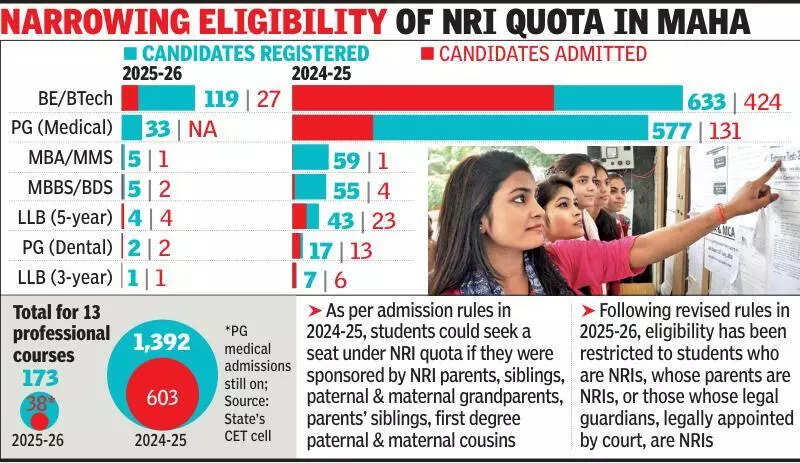
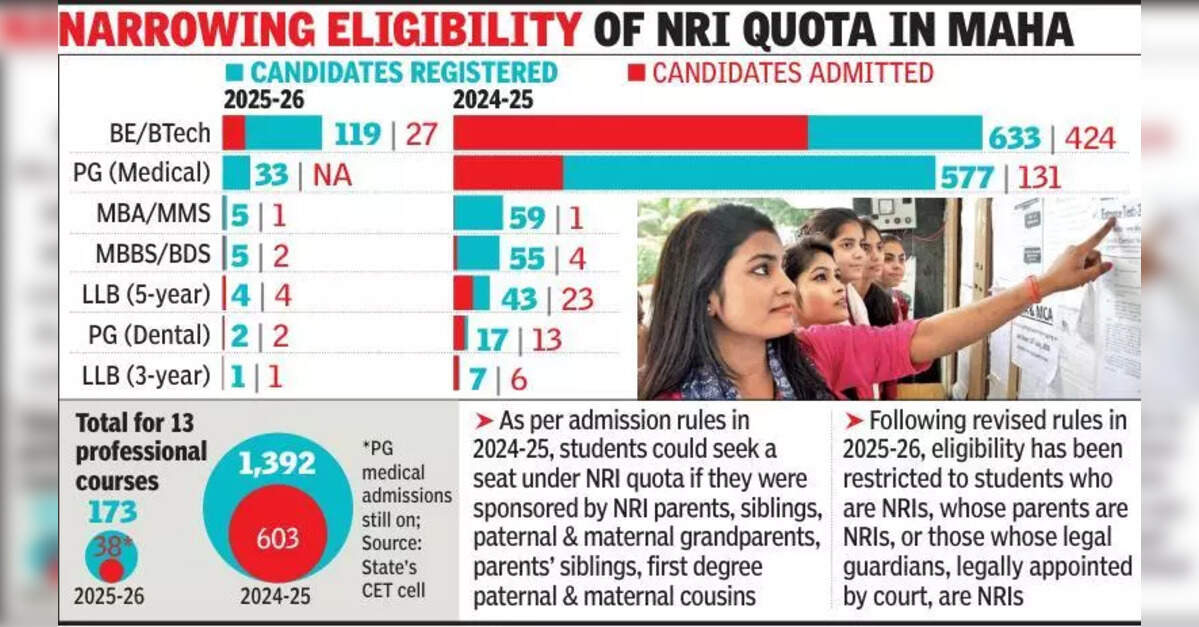
Mumbai: Applications for professional courses under the NRI quota in private colleges across the state plunged from 1,392 in 2024-25 to just 173 this academic year — a near 90% drop — after Maharashtra govt tightened norms to ‘curb misuse’ of the category, showed data from the state’s CET cell.
This quota allows students who do not manage to secure seats in general category, to use NRI status or sponsorship to get admission by paying substantially higher fees.
Maharashtra is probably the first state in the country to significantly narrow the eligibility under this quota to students who are themselves NRIs, whose parents are NRIs, or whose legal guardians, appointed under the Guardians and Wards Act, 1890, are NRIs. Earlier, students could seek admission under the quota if they were sponsored by NRI relatives such as siblings, grandparents or even uncles and aunts.
The change in the definition of ‘NRI’ in Maharashtra in June 2025, mooted under the guidance of higher and technical education minister Chandrakant Patil, has had an immediate impact on admissions in this academic session. In the previous admission cycle, 603 of the 1,392 applicants were admitted under NRI quota. This year, the number stands at just 38 so far, though a marginal increase is expected after PG medical admissions conclude. The vacant seats under the category are converted into management seats, where the fees are comparatively lower.
CET cell data showed that applications under the NRI quota are largely concentrated in courses such as engineering and postgraduate medical programmes, the latter having a limited number of seats and intense competition.
The Centre’s Medical Counselling Committee, which oversees medical admissions under the all-India quota as well as in central and deemed universities, continues to follow a broader framework that allows extended family members, too, to sponsor candidates. TOI had reported that 811 candidates had ‘changed their nationality’ from Indian to NRI to get seats in the third round of the PG medical admissions, of which only 113 were NRIs or children of NRIs and the rest were sponsored by first- or second-degree relatives.
Dileep Sardesai, CET cell commissioner, said they had noticed that most of the students taking advantage of the NRI quota were sponsored by relatives and distant relatives. “For the NRI quota, private medical colleges are allowed to charge up to five times the fees fixed by the Fee Regulatory Authority (FRA). The revised rules bring in transparency and will also benefit students in the long run,” said Sardesai.
Data from the cell shows that the highest number of applications under NRI category are historically received for BE/BTech, followed by PG medical admissions. Last year, of the 1,392 applicants, 633 were engineering aspirants and 577 were aspiring for PG medical seats. This year, after the numbers declined, the trend remains similar. Sudha Shenoy, a parent representative, however, said that engineering colleges not only reserve seats for foreign nationals, but also for children of Indians working in Gulf countries, which could be contributing to the higher numbers.
The amendment was challenged in court in four separate cases. While two of the matters have been dismissed by the Bombay High Court and its Aurangabad bench, two are still pending. Special Counsel for state and CET Cell, Pralhad Paranjape, said the Aurangabad bench of the HC dismissed the challenge, thereby upholding the state policy, which is also in accordance with the Supreme Court judgment in PA Inamdar v/s State of Maharashtra case.
Shenoy said that genuine students with higher merit scores, whose first-degree blood relatives were NRI, were benefiting from the earlier policy, but are now denied the opportunity. She said the competition is intense when it comes to PG medical admissions. A Tamil Nadu-based activist, Meeran, however, said that with the Centre lowering the eligibility criteria to zero percentile in NEET-PG, merit is no longer a bone of contention. The fact that students can benefit economically is important now, he added.

Source link