Lane Community College Board Approves Budget Reduction
The Lane Community College Board of Education voted to approve college leaders’ plans for a budget reduction on Jan. 7, despite fierce pushback from the faculty union. The latest controversy comes amid a dramatic year for the Oregon community college, marked by long, fractious board meetings and an ongoing battle between administrators and faculty over stalled labor negotiations and course cuts.
College administrators argue the approved proposal—cutting spending by $8 million over the next three years—is a financial necessity. They say the college regularly falls short of a board requirement to maintain 10 percent of its balance in reserves. Administrators also conducted a new multiyear forecast that predicted expenses are going to grow.
The college is expected to be “in a deficit every year … if we continue on the same trends that we have been in the last two or three years,” said Kara Flath, Lane’s vice president of finance and operations. The plan also proposes using some of the freed-up money for deferred maintenance and other projects.
But faculty union leaders disagree with the administration’s view of the college’s financial present and future. Adrienne Mitchell, president of the faculty union, the Lane Community College Education Association, believes leadership’s projections are pessimistic and that a roughly 8 percent cut to the $104 million operating budget is excessive.
“We don’t believe any of those cuts are necessary,” Mitchell said. “Currently, all of our funding sources—state funding, property taxes and student tuition revenue—are up.”
The union came out with an independent report last week suggesting that the college is in a sound financial position and should invest more, not less, in faculty and the campus over all. But faculty and administrators fundamentally disagree on how much spending will rise and what tranches of money the college has at its disposal.
The union’s perspective that the college can spend less “makes the numbers look better,” Flath said. “But as finance people, we have decades of finance experience” and such cost estimates are “not fiscally viable.”
Mitchell also argued that Oregon Local Budget Law requires the board to follow a legal process that includes forming a committee of board and nonboard members, presenting the budget and hosting a public hearing, before formally adopting a budget. The union put out a legal memo on the matter in September.
But administrators say their overarching plan isn’t the final budget—it doesn’t specify where exactly cuts will be made—so it doesn’t need to go through such a process yet. They said they plan to review programs, solicit community feedback and draw up a list of recommended cuts in the spring.
Board members, initially skeptical of the plan’s lack of specificity, held multiple ad hoc budget committee meetings last week to discuss it ahead of the meeting on Wednesday, which lasted almost five hours.
Board member Zach Mulholland said at the Wednesday meeting that he still sees “red flags and concerns with regards to unspecified cuts” but concluded, “at this moment in time, this appears to be a balanced proposal.” Mulholland and other board members on the ad hoc committee recommended the board move forward with the plan, as long as it includes annual updates and regular progress reports from administrators.
“Now maybe as a college we can work together,” Flath said.
Fraught Faculty Relations
But the college is also mired in other controversies. The faculty union, which represents about 525 full- and part-time professors, has been without a contract since June as administrators and faculty clash over the details.
Discussions have soured over disagreements about workloads, class-size limits, cost-of-living adjustments, the timing of layoff notices and the college’s efforts to strike some provisions, which Mitchell says amounts to a “net divestment” of over a million dollars in spending on faculty. The administration argued some of the issues in the proposed contract aren’t directly connected to faculty benefits, including proposals to add immigration status to the college’s nondiscrimination policy and ramp up campus safety measures.
Grant Matthews, vice president of academic affairs, said significant progress has been made since the summer, but “really, we’re stuck on economics.”
“We’re trying to really have a fiscally sustainable institution, and the proposals that we’re receiving at the table are not fiscally responsible,” he said. He estimated that the current contract proposal could cost the college up to $61 million.
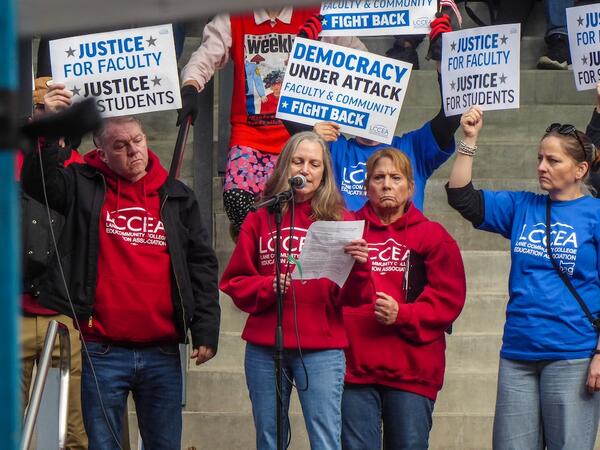
Professors aren’t pleased with how the process is going. In a December survey of 271 faculty members, 87 percent reported low morale, 90 percent said they didn’t trust the college’s president and 69 percent reported that they fear retaliation for expressing their views. The union has also raised concerns that faculty of color are leaving the college. On Wednesday, about 75 union members and supporters picketed outside ahead of the board meeting.
Two more bargaining sessions are planned for this month, and mediation is scheduled after.
Recent course cuts have also frayed relations between faculty and college leaders. Lane cut about 100 course sections for the winter and spring terms after introducing a new system that allows students to sign up in the fall for courses for the entire year.
Administrators said this is a typical number of course cuts for the college, on par with past years, to optimize their academic offerings, and advisers are ensuring students still get the classes they need. But Mitchell described the move as a blow to part-time faculty, who lost classes that might have filled up later in the year. The union filed an unfair labor practice complaint with the Oregon Employment Relations Board, arguing the eliminated courses should have been a part of bargaining. Mitchell also worries the cuts are a roadblock for students who need to take certain courses, noting that a popular biology class—a prerequisite for many health professions courses—has a wait list of 168 students.
Leadership Tensions
The board, meanwhile, has had its own share of drama over the past year.
The faculty union has accused administrators of encroaching on board responsibilities and criticized the board for failing to exercise its authority.
“There’s been a lot of controversy surrounding the administration essentially taking over the role of the Board of Education,” Mitchell said.
Meanwhile, in August, a third-party report concluded that Mulholland, formerly the board chair, and other board members discriminated against President Stephanie Bulger, a Black woman, on the basis of race and sex. The report described Mulholland and some other board members as displaying a dismissive or hostile attitude toward Bulger, cutting her off in conversations, and deferring questions to male staff. The report also found that Mulholland had intimidated a student. In September, the board censured the former board chair, who apologized, and the full board then came out with a joint apology.
“We are deeply sorry for the negative impact our behavior has had on you and the college community at large,” said Austin Fölnagy, the current board chair, who was also accused of adopting a dismissive tone toward the president. “President Bulger, please accept the board’s apology for treating you badly.”
Mitchell said the union is “very concerned about any type of discrimination, and we think it’s really important for everyone on the campus to feel safe.”
The college’s accreditor, the Northwest Commission on Colleges and Universities, also deemed the college “substantially in compliance” with accreditation standards but “in need of improvement” in a notice last March. The accreditor recommended the college evaluate its internal communication and ensure decision-making processes are “inclusive of all constituents,” among other suggestions.
Source link

You may also like

Sketch the Scene Forensic Science Activity Ideas