Adjectives Ending in L: The Teacher’s Guide
I understand the constraints. We are going deep, we are keeping it real, and we are absolutely banning those robotic corporate buzzwords
Let’s be honest for a second. How many times this week have you marked a piece of creative writing and circled the word “big”?
” The monster was big.” “The castle was big.” “The explosion was big.”
It’s disheartening, isn’t it? You know that child has an imagination absolutely bursting with vibrant, chaotic ideas, but when it comes to getting it down on paper, they hit a wall. Their vocabulary toolbox is just missing a few vital spanners.
Moving a child from “big” to “colossal,” or from “sad” to “tearful,” isn’t just about making their writing sound posher for the SATs moderators. It’s about giving them the precision to express what is actually going on in their heads. Oddly enough, a massive chunk of that descriptive power is locked away in adjectives ending in the letter ‘L’. Think about it. Magical. Powerful. Careful. Beautiful. Substantial.
In this guide, we are going to tackle the letter ‘L’. We will look at the spelling rules that trip kids up (and let’s admit it, some adults too), provide you with lists of words that go beyond the obvious, and I’ll share a practical, messy, “Attention Autism” inspired lesson plan that will get even your most reluctant writers using words like “ethereal.”
Check out our Quick “Letters Ending in Tool“
Why Suffixes Are Your Best Friend
You might be thinking, “Joe, I don’t have time for an intense grammar dive into suffixes on a Tuesday afternoon.”
Suffixes like -ful (full of) and -al (related to) are the quickest way to upgrade a child’s writing. They are force multipliers. Once a child understands that adding -ful turns a noun like “fear” into a descriptive adjective like “fearful,” they have suddenly unlocked dozens of new words without having to memorize them individually. It empowers them.
Instead of staring blankly at a thesaurus, they can take words they already know and manipulate them. It bridges the gap between simple labelling (That is a bear) to descriptive writing (That is a powerful bear).
But, as with everything in English literacy, there are traps waiting for the unsuspecting Year 3 student.

The Sticky Spelling Rules of ‘L’
Teaching adjectives ending in ‘L’ means you have to tackle spelling head-on. If you don’t, you are going to spend the next six months correcting “beautifull” and “magickle.”
Here are the main culprits we need to address in the classroom.
1. The “Full” vs. “-ful” Disaster
This is the big one. It drives me up the wall.
Children learn the word “full”. Their cup is full. They are full after lunch. It has two Ls.
So, logically, when they want to write that someone is “full of care,” they write “carefull.” It makes total sense in their developing brains.
We have to teach the specific rule: When “full” becomes a suffix at the end of a word, it drops an ‘L’.
It’s too lazy to carry both.
- Care + full = Careful
- Hope + full = Hopeful
- Play + full = Playful
Teacher Tip: I like to tell my younger classes that the suffix is a bit weak and can only carry one heavy ‘L’ bag. If you try to give it two, it drops one.
2. The ‘Y’ to ‘I’ Switcheroo
This is a classic rule that applies across many areas of spelling, but it’s crucial for adjectives ending in ‘L’.
If a base word ends in a consonant followed by a ‘y’ (like beauty, duty, or plenty), you must change the ‘y’ to an ‘i’ before adding the suffix -ful.
- Beauty -> Beautiful
- Plenty -> Plentiful
- Duty -> Dutiful
If you don’t explicitly teach this, you will get “beautyful” every single time. It looks wrong to us, but phonetically, the kids aren’t incorrect. They need the rule.
3. The Magical ‘-al’
The suffix -al usually means “relating to” or “having the character of.” It’s brilliant for turning concrete nouns into abstract descriptors.
- Magic -> Magical
- Music -> Musical
- Option -> Optional
The spelling here is usually straightforward, but the challenge is pronunciation. Often, the ‘a’ in ‘al’ gets swallowed up in speech. We say “music’l,” not “music-al.” You need to remind them that the ‘a’ is there, even if it’s being quiet.
4. What about ‘LE’?
You might have smart kids ask, “What about ‘little’ or ‘subtle’?”
These are tricky. Words ending in -le are often adjectives, but the -le isn’t usually a suffix we add to a base word in the same way.
- Subtle: It just is what it is.
- Gentle: You can’t take “gent” and add “le.”
For primary school purposes, it’s best to treat -le words as separate spelling patterns to learn, rather than suffix rules to apply. Don’t muddy the waters when you are trying to nail down the -ful rule.
Adjective Lists Ending in L
Here are categorised lists of adjectives ending in ‘L’. Don’t just dump these on the wall. Pick five a week. Integrate them into your oral storytelling. Drip-feed them until they stick.
Category 1: Emotions and Personality
These are fantastic for character descriptions. Get them away from “happy” and “nice.”
- Cheerful: Noticeably happy and optimistic. (Instead of: happy)
- Tearful: Crying or about to cry; very sad. (Instead of: sad)
- Fearful: Feeling afraid; showing anxiety. (Instead of: scared)
- Loyal: Giving or showing firm and constant support to a person or institution. (Great for stories about knights or friends).
- Thoughtful: Showing consideration for the needs of others; or, showing careful thought.
- Doubtful: Feeling uncertain about something.
- Ungrateful: Not showing gratitude for something received.
- Bashful: Reluctant to draw attention to oneself; shy.
Category 2: Size, Scale, and Impact
This is your “antidote to ‘big’” list.
- Colossal: Extremely large. (Think: giants, skyscrapers, mountains).
- Substantial: Of considerable importance, size, or worth. (A substantial meal, a substantial wall).
- Total: Complete; absolute.
- Abysmal: Extremely bad; appalling. (Often used for depth, like an abysmal pit, but great for describing terrible weather or a bad mood).
- Astronomical: Extremely large (literally related to astronomy, but used for huge numbers or sizes).
- Fatal: Causing death. (Serious stories only, perhaps!)
- Final: Coming at the end of a series.
Category 3: Abstract, Magical, and Atmosphere
These are the heavy hitters for setting a scene in creative writing. They add a layer of sophistication.
- Magical: Beautiful or delightful in a way that seems removed from everyday life.
- Mystical: Inspiring a sense of spiritual mystery, awe, and fascination.
- Ethereal: Extremely delicate and light in a way that seems too perfect for this world. (Great for describing ghosts, fairies, or light).
- Whimsical: Playfully quaint or fanciful, especially in an appealing and amusing way.
- Surreal: Having the qualities of a dream; bizarre.
- Artificial: Made or produced by human beings rather than occurring naturally.
- Celestial: Positioned in or relating to the sky, or outer space as observed in astronomy.
Adjectives Ending In L By Number of Letters
3 Letter Adjectives Ending In L
Truly pure adjectives of three letters ending in ‘L’ are rare!
4 Letter Adjectives Ending In L
- Cool: At a fairly low temperature; or fashionable.
- Dull: Lacking brightness or interest; boring.
- Evil: Profoundly immoral and wicked.
- Full: Containing as much as possible.
- Real: Actually existing; not imitation.
- Tall: Of great height.
- Well: In good health. (e.g., “I feel well”).
5 Letter Adjectives Ending In L
- Civil: Relating to ordinary citizens; or, polite.
- Dual: Consisting of two parts.
- Equal: Being the same in quantity, size, or value.
- Fatal: Causing death.
- Final: Coming at the end.
- Ideal: Perfect; satisfying one’s conception of the best.
- Local: Relating to a particular area or neighborhood.
- Loyal: Giving firm and constant support.
- Moral: Concerned with the principles of right and wrong.
- Naval: Relating to a navy or ships.
- Novel: Interestingly new or unusual (e.g., “A novel idea”).
- Oral: Spoken rather than written.
- Oval: Having a rounded and slightly elongated outline.
- Regal: Resembling or fit for a monarch; magnificent.
- Royal: Having the status of a king or queen.
- Rural: Relating to the countryside rather than the town.
- Total: Complete; absolute.
- Usual: Habitually or typically occurring.
- Vital: Absolutely necessary; essential.
- Vocal: Relating to the human voice; or, outspoken.
6 Letters
- Actual: Existing in fact.
- Annual: Occurring once every year.
- Brutal: Savagely violent.
- Casual: Relaxed and unconcerned.
- Dismal: Depressing; dreary.
- Formal: Done in accordance with rules or convention.
- Frugal: Careful with money or food.
- Global: Relating to the whole world.
- Lawful: Permitted by law.
- Lethal: Sufficient to cause death.
- Little: Small in size, amount, or degree.
- Mental: Relating to the mind.
- Mortal: Subject to death (e.g., “All men are mortal”).
- Normal: Usual, typical, or expected.
- Social: Relating to society.
- Stable: Not likely to give way or overturn; firmly fixed.
- Useful: Able to be used for a practical purpose.
- Verbal: Relating to or in the form of words.
7 Letter Adjectives Ending In L
- Awkward: Causing or feeling embarrassment or inconvenience.
- Careful: Making sure of avoiding potential danger.
- Central: At the point or area in the middle.
- Crucial: Decisive or critical, especially in the success or failure of something.
- Digital: Relating to computer technology (or fingers!).
- Eternal: Lasting or existing forever.
- Ethical: Relating to moral principles.
- Fearful: Feeling afraid; showing anxiety.
- Gradual: Taking place or progressing slowly or by degrees.
- Helpful: Giving or ready to give help.
- Illegal: Contrary to or forbidden by law.
- Initial: Existing or occurring at the beginning.
- Joyful: Feeling, expressing, or causing great pleasure.
- Liberal: Open to new behavior or opinions; or, given/used in generous amounts.
- Logical: Characterized by clear, sound reasoning.
- Medical: Relating to the science of medicine.
- Musical: Having a pleasant sound; melodious.
- Natural: Existing in or caused by nature.
- Neutral: Not supporting or helping either side in a conflict.
- Painful: Affected with or causing pain.
- Partial: Existing only in part; incomplete.
- Playful: Fond of games and amusement; lighthearted.
- Radical: Relating to the fundamental nature of something; thorough.
- Special: Better, greater, or otherwise different from what is usual.
- Several: More than two but not many.
- Typical: Having the distinctive qualities of a particular type.
- Virtual: Almost or nearly as described.
8+ Letters (Complex Descriptors)
- Abnormal: Deviating from what is normal or usual.
- Chemical: Relating to chemistry or the interactions of substances.
- Colossal: Extremely large.
- External: Belonging to or forming the outer surface or structure of something.
- Graceful: Having or showing grace or elegance.
- Grateful: Feeling or showing an appreciation of kindness.
- Imperial: Relating to an empire.
- Internal: Of or situated on the inside.
- Material: Denoting or consisting of physical objects rather than the mind or spirit.
- National: Relating to a nation; common to a whole nation.
- Official: Relating to an authority or public body.
- Optional: Available to be chosen but not obligatory.
- Original: Present or existing from the beginning.
- Peaceful: Free from disturbance; tranquil.
- Personal: Of or concerning one’s private life, relationships, and emotions.
- Physical: Relating to the body as opposed to the mind.
- Powerful: Having great power or strength.
- Practical: Of or concerned with the actual doing or use of something rather than with theory.
- Regional: Relating to or characteristic of a region.
- Seasonal: Relating to or characteristic of a particular season.
- Shameful: Worthy of or causing shame or disgrace.
- Skeptical: Not easily convinced; having doubts or reservations.
- Specific: Clearly defined or identified.
- Tactical: Showing adroit planning; aiming at an end beyond the immediate action.
- Terminal: Forming or situated at the end or extremity of something; or, predicted to lead to death.
- Tropical: Of, typical of, or peculiar to the tropics.
- Vertical: At right angles to a horizontal plane; up and down.

The Classroom Activity: Magical Potions (Attention Autism)
If you just put a list of words on the board and ask them to write sentences, you’ve lost half the class before you even start. My SEN kids will check out immediately, and the rest will just go through the motions.
We need an experience. We need a hook. I use the “Attention Autism” framework (developed by Gina Davies) for a lot of my literacy teaching. It’s designed to capture attention, sustain it, and then shift it towards a shared activity. It works brilliantly for the whole class, neurotypical or otherwise.
Theme: The Wizard’s Workshop.
Target Adjectives: Magical, colourful, mystical, ethereal, substantial, colossal, powerful.
Stage 1: The Bucket (To Grab Attention)
You need a bucket filled with visually stimulating objects. You are going to pull them out, name them excitedly, and put them back. Do not ask questions. This is just about showing them cool stuff to get their eyes on you.
- What’s in my bucket?
- I’ve got a… flashing light-up bouncy ball! (Drop it, watch it flash). Into the bucket.
- I’ve got a… silky, shiny scarf! (Wave it around). Into the bucket.
- I’ve got a… wind-up chattering teeth toy! (Let it chatter on the desk). Into the bucket.
- Bucket time is finished.
Stage 2: The Attention Builder (The Main Event)
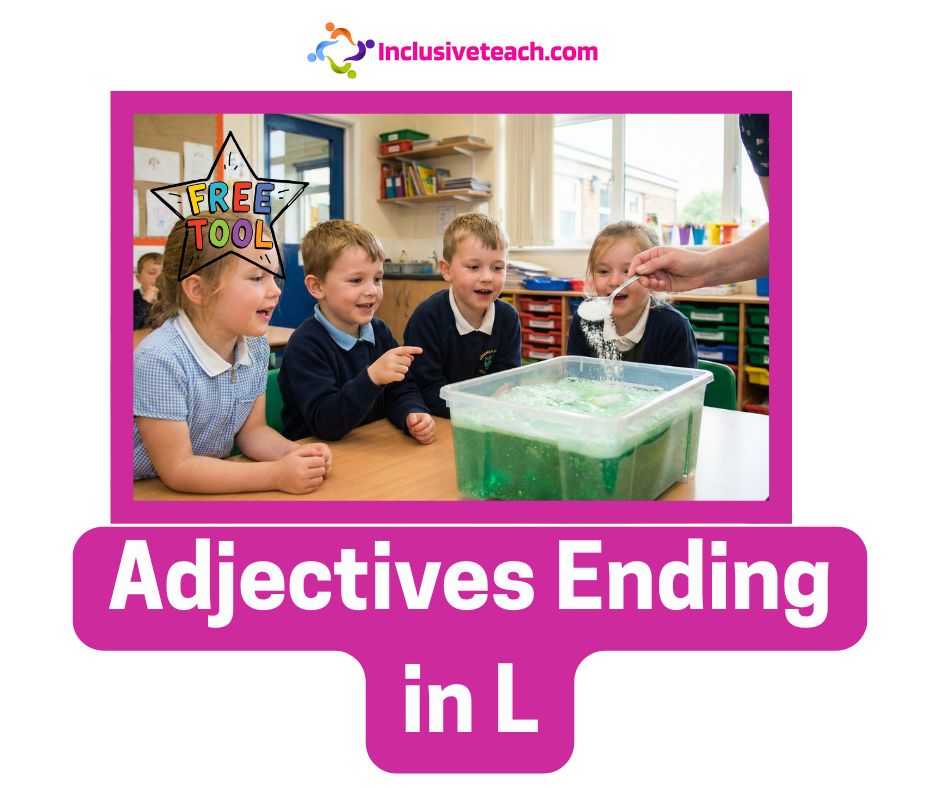
This is where you model the language. You are the wizard. You need a clear plastic container, vinegar, food colouring, glitter, and baking soda.
You are going to create a “potion” reaction.
- Action: Pour vinegar into the container. Add green food colouring and glitter. Stir it slowly.
- Narrate with ‘L’ words: “I am mixing a magical potion. It looks mystical and green. It is a colourful liquid.”
- The Climax: “Now for the power powder!” (Dump a large spoonful of baking soda in).
- Narrate the reaction: As it fizzes up hugely: “Wow! Look at that colossal reaction! It is substantial! It’s rising up. It looks ethereal and bubbly. What a powerful potion!”
Do this a couple of times. Keep your language focused on those descriptive ‘L’ words. Don’t over-talk it. Let the visual do the work.
Stage 3: Turn Taking (Shifting Attention)
Now the kids want a go. You invite them up one by one (or in pairs) to add one ingredient to a communal class potion.
- “Sarah, come and add the magical glitter.”
- “Tom, come and pour in the colourful liquid.”
- “Leo, you add the final ingredient.”
Keep narrating their actions using the target adjectives.
Stage 4: Independent Work (Transitioning to Learning)
Now that they are buzzing with the imagery of the fizzing, glittery potions, send them to their tables.
- The Task: Draw your own magical potion bottle.
- The Writing: They must label their potion with at least three adjectives ending in ‘L’ that describe what it does or what it looks like.
- Example: “My potion is magical, colourful, and creates a colossal explosion.”
Differentiation: Joe’s Corner
How do we make this work for everyone? For your SEN / Lower Prior Attainers:
Don’t ask them to recall the spelling rules and the vocabulary at the same time. That’s cognitive overload.
- Give them a word mat with pictures linking to the specific ‘L’ words you used in the demonstration (e.g., a picture of the giant fizz with the word “colossal” next to it).
- Use cloze procedures (fill-in-the-blanks): “The potion was ______ (magic/magical).” Let them circle the correct spelling.
For your Greater Depth / High Flyers:
Challenge them with the abstract.
- Don’t just describe the potion physically. Describe what the potion does to someone’s personality.
- “After drinking the vial, the knight felt fearful yet loyal to his king.”
- Ask them to use the “Y to I” rule words in a complex sentence.
Wrapping It Up
Adjectives ending in ‘L’ are bread-and-butter descriptors. They are tools that allow children to step away from basic nouns and start painting pictures with words.
It takes time. You’ll be correcting “carefull” until the day you retire. But when you see a child suddenly use “ethereal” to describe fog in a story because they remembered the glitter in your potion lesson?
Related
Discover more from Special Education and Inclusive Learning
Subscribe to get the latest posts sent to your email.
Source link

You may also like
Adjectives Ending in E For Phonics and Reading Skills
Adjectives Ending in M