2040 is SO Not Boring! I’m 11 and Always Learning
We are living in someone’s imagined future. To build differently, we first have to imagine a better one. Find more stories from the future here.
Hi! My name’s Leo, and I’m 11 years old. My mom says I should tell you about my school. “They won’t believe it,” she says. When I hear my mom talk about “school” back when she was a kid, it sounds… well, super boring. They had to go to the same building every single day, sit in rows (where chairs were attached to desk?!), and just like remember a list of stuff that everyone had to learn. My school is way, way cooler, and it’s basically my whole city!
My day usually starts with my buddy, Scout. Scout isn’t a person, but my super smart AI companion. On most days, we talk over breakfast. Scout asks me about last night’s dreams, and I ask Scout about… well… everything. Last night I had a dream where I was talking to a giant mushroom, and it had Scout’s voice. Scout thought that was pretty funny.
After breakfast, I spend a few minutes “Casting.” It’s a new way to turn our thoughts into interesting shapes and colors in the air. I use my hands in the air to sculpt, like a sand castle; it’s kind of like a stretch, but for my mind. When I’m done, Scout and I talk through my progress on my customized learning path—a map that tells where I’ve been and shows where I’m going, alongside the big questions I’ve been asking lately. Today, I decided I want to learn about how cities stay clean and look so cool, even though there are so many people! See what I mean? This is “school” for me, and it’s awesome because I get to choose what, when, and how I learn most of the time. My Learning Guides (what they used to call teachers) always say that following real questions helps us learn better.
My Morning
Today, my mom and I walk to New Horizon (my school) and spend most of our time noticing things and talking about them. This is where I first asked about clean streets. I saw a car drive by that had hoses on the back and some robots on top that would pick up trash and polish the pavement as it scooted by. I got distracted as I watched it by a squash hanging off the roof of a three-story townhouse. That might sound funny, but every building has a garden on its rooftop, like giant salads growing up high, and all the windows are solar panels. My parents won’t stop talking about how different that was from back when my grandparents were kids and only farmers grew what they ate at home. A group of teenagers pulls me out of imagining a world without solar power. They’re doing the much cooler version of “Casting” called “Glimmercasting” with their friends. Someday I’ll be able to do it too! It’s like they’re dancing with light, creating super crazy pictures in the air that disappear really fast. It looks like a game, but it’s actually teaching us how to think about stuff in new and different ways. My mom says it really helps kids be creative and think outside the box.
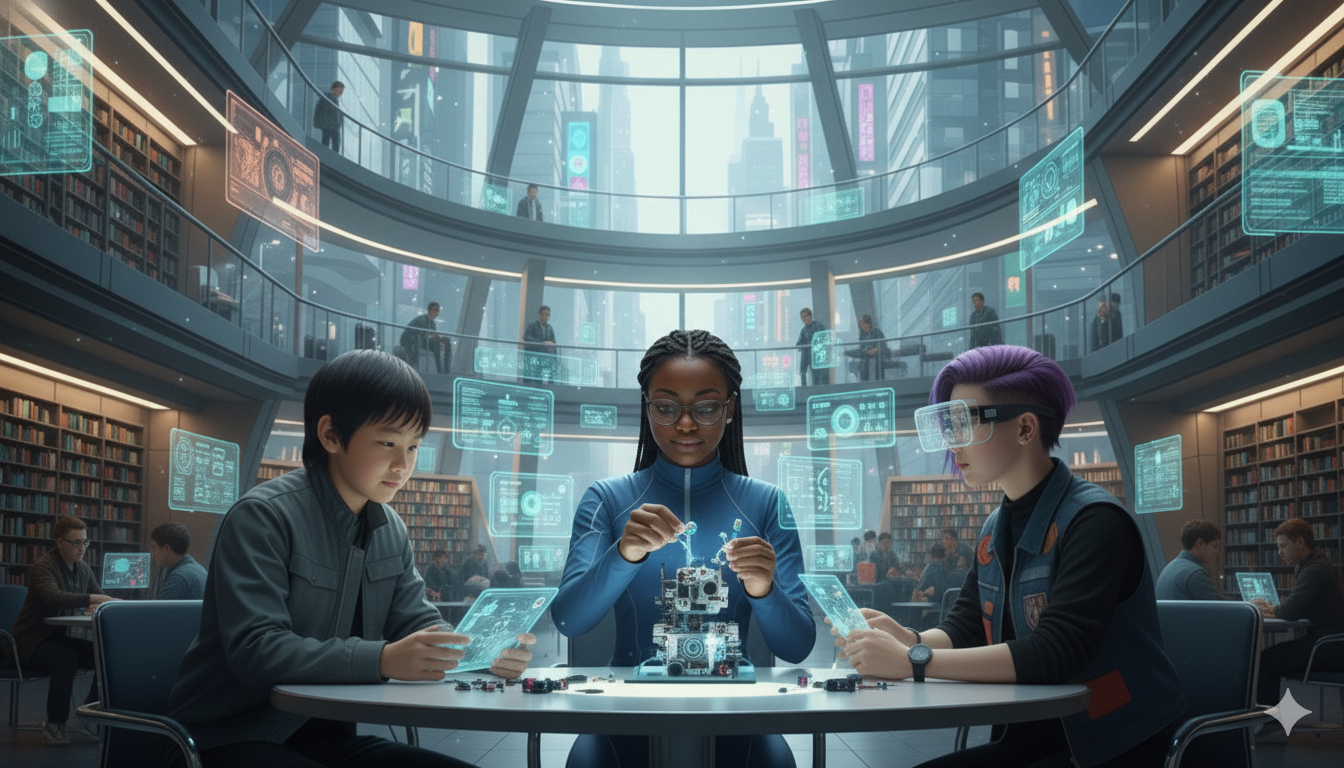
We head up to my Home School, a big community space inside our public library. Inside, it’s bright and airy, full of buzzing machines and brains, and lots of older and younger kids working on projects. I’m led to a circular-shaped table in the corner where there are two people waiting for me—my team for the next couple of weeks! One is an older kid named Chloe, and the other is a grown-up mentor who designs bridges in the city, named Devon. All our Learning Guides ensure that any adult mentors we work with have undergone a city-wide background check and are super-duper verified in the system. It’s like they have a special “good person” badge on their LER, too!
When I take pictures or record my voice explaining my ideas, that evidence goes into my Learner Employment Record (LER). But it’s my stuff. Only my mentor, Ms. Elena, and my parents can see all of it, unless I push a button to share it. No sneaky peeking! It’s like a photo album of my brain getting smarter that tracks what I’m good at and shows how I’m learning.
During our break, we eat lunch. My team and I give each other digital high-fives for learning, we talk about what went well and where we got stuck. My mentor even adds a quick note about how good I am at putting different ideas together. All of this reflection and feedback gets attached as evidence to this project, which has lots of other photos, videos, and reflections that we made along the way. It all gets stored beside all of my other learning experiences (like the frog that I caught and am raising at home!), and when I mark the project as complete Scout tells me that curiosity is my superpower and my ability to collaborate is climbing!
My Afternoon
After lunch, Ms. Elena comes to the library and she takes me, my friend Jax and five other kids to the park. It’s not just for playing; it’s a giant lab! We all have different projects we are working on, but first, we’re going to play “Rotten Egg.” It’s a super fun game we made up with a really squishy ball.
Jax is heading to the community garden to look at some of the seeds they planted a few weeks ago. He finds tiny green sprouts pushing up, and I hear him add a voice note that he’s “feeling lowkey proud that they’re growing” right before “uh-oh,” when he notices the ones on the other side of him aren’t. Scout suggests he add a new hypothesis to his journal about what the problem might be.
One of the other learners is De’Shawn, who’s measuring angles of the slides we built in our engineering project with the team from the local design studio. He really thinks we can go down way, way faster if we make them steeper, so he’s using a handheld scanner to send the numbers back to our design team with his pitch.
I’m going to look at the trash cans to see how full they are. It will be tricky because they’re all underground now. Scout helps me pull up a map, and I look for the symbols on the ground that show where I can lift the caps and drop in the tiny light and camera. I log the data and notice right away that once again, the same trash can by the soccer field is about to overflow while the others are almost empty. I bet it’s all those team snacks!
On the way back, Ms. Elena asks if I was able to get enough info from the light and camera. She’s been hearing my groan about how annoying it is that it’s like a scavenger hunt every time I want to log more data for my project. She asked me if I ever thought about designing a new way to help everyone see the trash levels. “Oh, like a colored light or a meter or something that lets people know how close to full it is?” “Now you’re thinking like a designer,” she said as she patted me on the back. “Definitely share that idea in your City Clean Up Project!” This is soooo what Ms. Elena is good at, noticing things I don’t even notice about myself and then telling me anything is possible. And that’s not all she does. She’s the one who helps me understand the why behind what I’m learning – how it helps me thrive and makes our city better. Ms. Elena checks my LER, not just to track my skills, but to make sure I’m happy and not too tired. She always says she wants our heads and hearts ready to learn!
Wrapping Up My Day
When I get home, I spend a few minutes talking with Scout about my day. They help me think about what felt new and scary and what felt really comfortable. Of course, I ask any questions that I have to add to my Curiosity Dashboard. My LER automatically updates, showing me that I’m getting stronger in many skills, just like when I level up in video games.
After that, I sit on the porch with my parents and we talk about the day. We play this game where my mom asks me what I did, and my dad tries to guess what skills I gained. (Yes, he thinks he’s smarter than Scout.) We’re always joking that he says every single thing I do counts as learning, but he’s actually right.
All these different places—my Home School, the park, my house, everything I do is all connected, and it all “counts.” I sometimes do get annoyed by all the “in the olden days” stories from my grandparents and parents, but it’s actually pretty crazy to hear about how they did things for so long.
Signals from the Future
This possible future was based on the following signals from communities and projects worldwide.
A Cleaner City: Amsterdam’s smart waste system uses underground garbage bins equipped with sensors that track fullness levels and optimize collection routes. By combining design thinking, data, and sustainability, the city keeps public spaces cleaner while reducing traffic and emissions. These systems are now inspiring students and engineers alike to rethink how everyday infrastructure can become a living part of urban learning.
A Learning Library: E3 Civic High in San Diego is a public charter high school located inside the city’s downtown library. This co-location turns a civic space into a hub for learning, mentorship, and community engagement. As libraries evolve into shared campuses with maker labs, co-working zones, and mentorship programs, they point toward a future where schools and communities learn side-by-side.
A Connected City: In Columbus, Ohio, the Columbus EcosySTEM initiative is transforming the entire city into a learning network. Schools, libraries, and local organizations collaborate to connect students with hands-on learning across the city—from energy labs and arts spaces to civic projects and tech hubs. By treating Columbus as a “community campus,” educators are creating new pathways for learners to explore real-world problems while developing skills that strengthen the region’s future workforce.
City-as-Classroom: In Newport, Rhode Island, FabNewport has helped transform the city into a living classroom where learning happens everywhere. Through partnerships with local artists, engineers, and civic leaders, students design and lead community-based projects that connect their studies to real-world impact. From marine science on the docks to digital fabrication in makerspaces, Newport’s learner-centered ecosystem shows how a small city can unlock big opportunities.
Source link

You may also like

A Look Back: Try Out My New Free AI Chatbot For ELL Teachers