100 Words Ending in Y: The Ultimate School List
Words Ending in Y: The Ultimate School List
You know what? The letter Y is the troublemaker of the alphabet.
Honestly, it causes more confusion in my classroom than any other letter. Is it a consonant? Is it a vowel? Why does it sound like “Eye” sometimes and “Ee” other times?
When I am teaching my special needs students, or even just helping my own kids with homework, I call Y “The Copycat.” It doesn’t really have its own sound at the end of a word. It likes to steal sounds from I and E.
Here is the general rule we teach in school:
- Short words (1 syllable): The Y usually sounds like I (as in Fly).
- Longer words (2+ syllables): The Y usually sounds like E (as in Baby).
Of course, because this is English, there are exceptions. But this rule works about 90% of the time.
Here is a list sorted by length to help you teach this tricky concept.
You may also like our post – Words ending in A
2 Letter Words Ending in Y (The “I” Sound)
These are some of the first sight words a child learns. In these tiny words, the Y screams its name. It makes the long “I” sound.
There are not many of them, but they are very important for building simple sentences.
- By: Used to identify the agent performing an action. “Written by Joe.”
- My: Belonging to me. This is one of the first possessive words kids use.
Teaching Tip:
Since there are only two common ones here, I use them to teach handwriting. The letter Y hangs down “below the line.” Kids often float it in the air. Remind them that the tail of the Y needs to dig into the dirt.
3 Letter Words Ending in Y (The “I” Sound)
This is the “Fly in the Sky” group.
Almost all three-letter words ending in Y make the long I sound. They rhyme with “Pie.”
These are action words (verbs) or descriptive words (adjectives). They are great for teaching rhyming because the pattern is so consistent.
- Cry: To shed tears. A very common word in early emotional regulation.
- Dry: Not wet.
- Fly: To move through the air, or an insect.
- Fry: To cook in hot oil.
- Ply: Thickness or layer (like toilet paper).
- Pry: To force open.
- Shy: Nervous or timid. I work with many shy students; it is a good word to know.
- Sky: The atmosphere above the earth.
- Sly: Cunning or deceitful.
- Soy: A bean used for food. (Wait! This is an exception. It makes the “Oy” sound. Good to point out).
- Spy: A secret agent.
- Sty: A pig pen.
- Try: To attempt something.
- Why: A question word.
The “Key” Exception:
You have to watch out for the word Key. It has three letters, but it makes the E sound. Why? Because the E is helping the Y. They work as a team.

4 Letter Words (The Shift Begins)
This is where things get interesting. We are moving from one syllable to two syllables.
As soon as you add that second syllable, the Y usually gets tired. It stops screaming “I” and settles down to say “E”.
The “E” Sound (Two Syllables)
These are the most common. You will see these in 2nd and 3rd-grade reading books constantly.
- Baby: An infant.
- Body: The physical structure of a person.
- City: A large town.
- Copy: To duplicate.
- Duty: A moral or legal obligation.
- Easy: Not difficult.
- Envy: Jealousy.
- Fury: Wild or violent anger.
- Holy: Dedicated to God.
- Lady: A polite term for a woman.
- Lily: A flower.
- Many: A large number. (A sight word must-know).
- Navy: A dark blue color or military force.
- Only: Alone or single.
- Pony: A small horse.
- Ruby: A red gem.
- Tiny: Very small.
- Ugly: Unpleasant to look at.
- Very: Used for emphasis.
The “I” Sound (Exceptions)
There are still some 4-letter words where Y shouts “I”. Usually, this is because the word still only has one syllable, or the stress is on the end.
- Ally: To unite. (Verb form: “To ally with someone”).
- Deny: To state that something is not true.
- Rely: To depend on.
- July: The month.
Lesson Idea:
Write “Baby” and “Deny” on the board. Clap the syllables.
Ba-by (Stress on Ba). The Y is weak. It says E.
De-ny (Stress on Ny). The Y is strong. It says I.

5 Letter Words Ending in Y (The Adjective Factory)
If you are teaching creative writing, this list is gold.
Adding Y to the end of a noun often turns it into an adjective.
- Sun -> Sunny
- Fun -> Funny
- Mess -> Messy

In almost all of these cases, the Y makes the E sound.
- Angry: Feeling mad.
- Berry: A small fruit.
- Carry: To hold and transport.
- Dairy: Milk products.
- Dirty: Not clean.
- Early: Before the expected time.
- Empty: Containing nothing.
- Enemy: Opponent.
- Entry: A way in.
- Every: All members of a group.
- Fairy: A mythical creature.
- Fancy: Elaborate.
- Funny: Causing laughter.
- Glory: High renown or honor.
- Happy: Joyful.
- Heavy: Of great weight.
- Jelly: A fruit spread.
- Lucky: Having good fortune.
- Marry: To join in marriage.
- Merry: Cheerful.
- Messy: Untidy.
- Nasty: Unpleasant.
- Party: A social gathering.
- Penny: A coin.
- Puppy: A young dog.
- Ready: Prepared.
- Silly: Foolish.
- Sorry: Feeling regret.
- Story: A narrative.
- Study: To learn.
- Tummy: Stomach.
- Windy: With a lot of wind.
- Worry: To feel anxious.
The “Apply” Exception:
Again, we have verbs that break the rule. Apply, Reply, Supply. They all end in the “I” sound. They are related to that 4-letter list (Rely, Deny).
6 Letter Words Ending in Y
These words are staples of middle school vocabulary. They represent abstract concepts (Beauty, Theory) and adverbs (Slowly, Safely).
The “E” sound is dominant here.
- Beauty: A combination of qualities that pleases the senses.
- Brandy: A strong alcoholic spirit.
- Cherry: A red fruit.
- Colony: A settlement.
- County: A political division of a state.
- Energy: The strength to do work.
- Family: Parents and children.
- Groovy: Fashionable and exciting.
- Hungry: Needing food.
- Injury: Physical harm.
- Jersey: A shirt worn by a sports player.
- Luxury: Great comfort.
- Memory: The ability to remember.
- Melody: A sequence of notes.
- Nobody: No person.
- Plenty: A full amount.
- Poetry: Literary work.
- Pretty: Attractive.
- Remedy: A medicine or treatment.
- Rosary: A form of prayer.
- Salary: Regular pay.
- Steady: Firmly fixed.
- Theory: A system of ideas.
- Turkey: A large bird.
The “-LY” Adverbs:
You cannot talk about Y without talking about L-Y. We add LY to words to tell us how something is done.
- Slowly
- Safely
- Rarely
- Lately
- BarelyThe Y always says E in these words.
7+ Letter Words Ending in Y
These are the academic words. You will see many words ending in -ogy (study of) or -ity (state of being).
- Academy: A place of study.
- Anatomy: The structure of a body.
- Already: Before now.
- Balcony: A platform on a building.
- Battery: A power source.
- Century: One hundred years.
- Company: A business.
- Custody: Protective care.
- Economy: The wealth and resources of a country.
- Factory: A building where goods are made.
- History: The study of past events.
- Holiday: A day of celebration. (Note: Originally “Holy Day”).
- Journey: An act of traveling.
- Liberty: Freedom.
- Library: A place with books. (One of the most important words in school!).
- Mystery: Something difficult to explain.
- Penalty: A punishment.
- Poverty: The state of being poor.
- Privacy: The state of being free from attention.
- Quality: The standard of something.
- Society: People living together in a community.
- Therapy: Treatment to relieve a problem.
- Victory: Winning.

Why Does This Matter? (The Spelling Rule)
You might wonder why we obsess over the sound the Y makes.
It matters because of the “Change Y to I” rule.
When we want to make a word plural, or put it in the past tense, we have to look at the letter before the Y. But for kids, listening to the sound helps them remember the rule.
If a baby cries, we change the Y to I and add ES.
Baby -> Babies
If a bird flies, we change the Y to I and add ES.
Fly -> Flies
If we play a game, we just add S.
Play -> Plays (Because the A is protecting the Y).
How to Teach This List
Here is how I do it in my classroom.
1. The “Sound Sort”
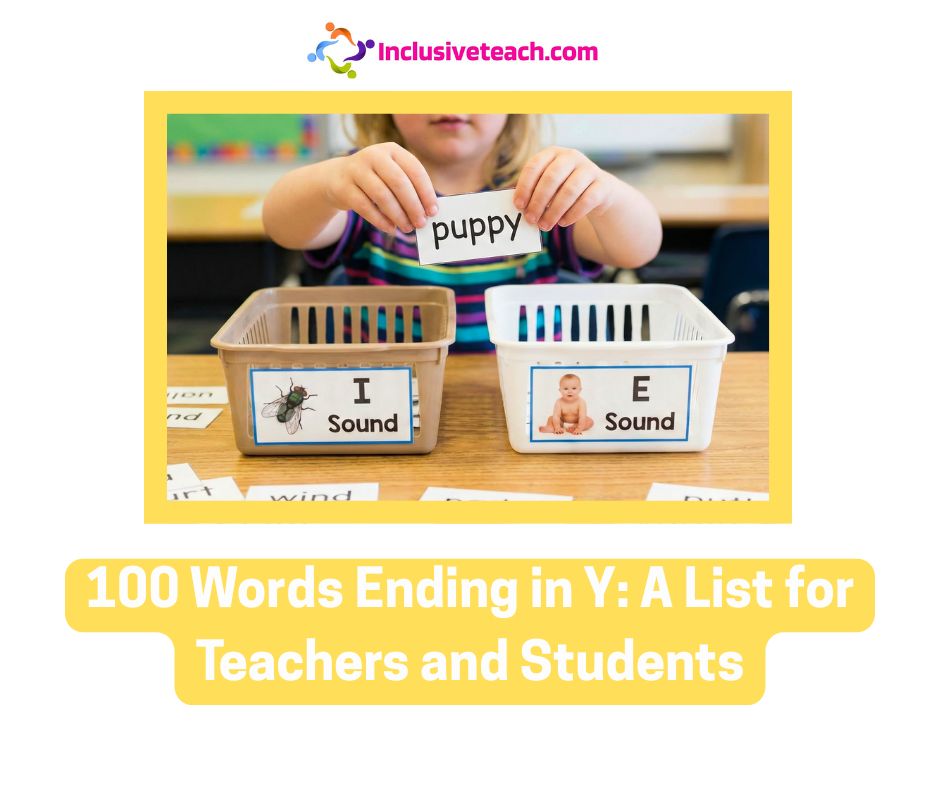
I give the students a stack of cards with words on them. I put two baskets on the table.
- Basket 1: A picture of a Fly (for the I sound).
- Basket 2: A picture of a Baby (for the E sound).They have to read the card and toss it in the right basket. It gets them moving and listening.
2. The Adjective Game
I say a noun, and they have to turn it into a Y adjective.
- Teacher: “Cloud.”
- Student: “Cloudy!”
- Teacher: “Mud.”
- Student: “Muddy!”(Remind them to double the consonant for short vowels like Mud/Muddy and Sun/Sunny).
Final Thoughts
The letter Y is a hardworking letter. It finishes so many of our sentences.
By breaking it down into “Short Word = I” and “Long Word = E,” you give children a tool they can use. It stops being a guessing game and starts being a pattern.
And honestly, once a child sees the pattern, their reading speed takes off.
Good luck with the lesson planning.
Would you like me to tackle “Words with Silent Letters” next? That is another huge topic for schools.
Related
Discover more from Special Education and Inclusive Learning
Subscribe to get the latest posts sent to your email.
Source link

You may also like
Understanding the Concrete-Pictorial-Abstract (CPA) Approach
Words That Sound the Same: A Visual Homophone Guide