Would You Want a Robot to Do Your Daily Chores?
Would you want someone to clean your room? Do your dishes? Throw out your trash? And never complain — or get tired?
If so, you might be in luck!
Soon you and your family will have a chance to purchase an A.I.-powered robot to fulfill all of your chore-ending dreams.
Are you ready to share your home with a humanoid to do all of your daily chores? Or does the idea of a robo-butler creep you out?
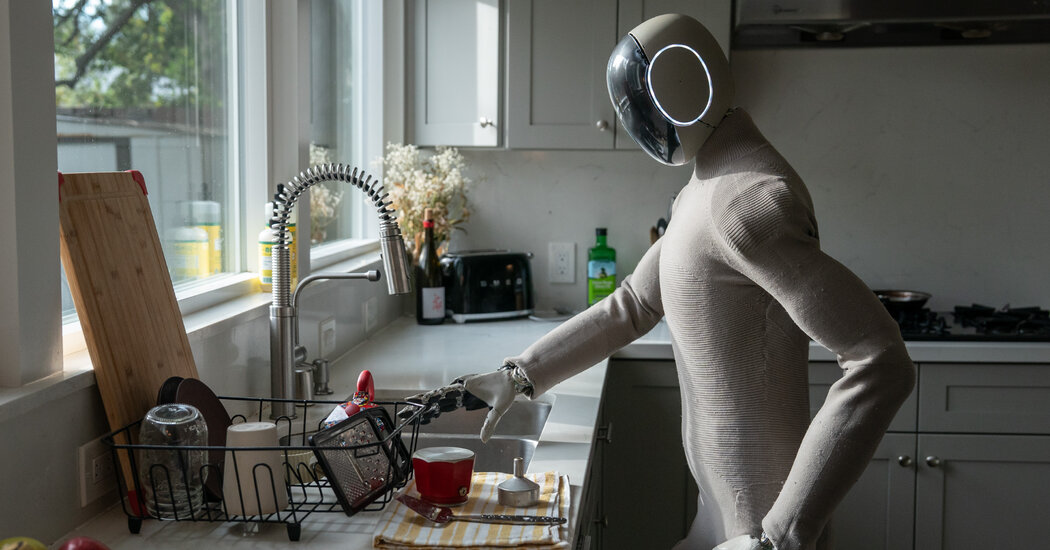
In the article “Invasion of the Home Humanoid Robots,” with photographs and video by David B. Torch and Loren Elliott, the technology reporter Cade Metz writes about his recent visit to meet Neo, a humanoid that its creator hopes will be in homes by the end of the year:
On a recent morning, I knocked on the front door of a handsome two-story home in Redwood City, Calif. Within seconds, the door was opened by a faceless robot dressed in a beige bodysuit that clung tight to its trim waist and long legs.
This svelte humanoid greeted me with what seemed to be a Scandinavian accent, and I offered to shake hands. As our palms met, it said: “I have a firm grip.”
When the home’s owner, a Norwegian engineer named Bernt Børnich, asked for some bottled water, the robot turned, walked into the kitchen and opened the refrigerator with one hand.
Artificial intelligence is already driving cars, writing essays and even writing computer code. Now, humanoids, machines built to look like humans and powered by A.I., are poised to move into our homes so they can help with the daily chores. Mr. Børnich is chief executive and founder of a start-up called 1X. Before the end of the year, his company hopes to put his robot, Neo, into more than 100 homes in Silicon Valley and elsewhere.
His start-up is among the dozens of companies planning to sell humanoids and get them into both homes and businesses. Investors have poured $7.2 billion into more than 50 start-ups since 2015, according to PitchBook, a research firm that tracks the tech industry. The humanoid frenzy reached a new peak last year, when investments topped $1.6 billion. And that did not include the billions that Elon Musk and Tesla, his electric car company, are pumping into Optimus, a humanoid they began building in 2021.
Entrepreneurs like Mr. Børnich and Mr. Musk believe humanoids will one day do much of the physical work that is now handled by people, including household chores like wiping counters and emptying dishwashers, warehouse jobs like sorting packages and factory labor like building cars on an assembly line.
Neo is a little less than five and a half feet tall and weighs 66 pounds. It is guided by cameras in its eyes and other sensors, but it needs a lot of human support:
Neo said “Hello” with a Scandinavian accent because it was operated by a Norwegian technician in the basement of Mr. Børnich’s home. (Ultimately, the company wants to build call centers where perhaps dozens of technicians would support robots.)
The robot walked through the dining room and kitchen on its own. But the technician spoke for Neo and remotely guided its hands via a virtual reality headset and two wireless joysticks. Robots are still learning to navigate the world on their own. And they need a lot of help doing it. At least, for now.
The article continues:
If I stepped into Neo’s path, it would stop and move around me. If I pushed its chest, it stayed on its feet. Sometimes, it stumbled or did not quite know what to do. But it could walk around a room much like people do.
“All of this is learned behavior,” Mr. Jang said, as Neo clicked against the floor with each step. “If we put it into any environment, it should know how to do this.”
Training a robot to do household chores, however, is an entirely different prospect.
Because the physics of loading a dishwasher or folding laundry are exceedingly complex, 1X cannot teach these tasks in the virtual world. They have to gather data inside real homes.
When I visited Mr. Børnich’s home a month later, Neo started to struggle with the refrigerator’s stainless-steel door. The robot’s Wi-Fi connection had dropped. But once the hidden technician rebooted the Wi-Fi, he seamlessly guided the robot through its small task. Neo handed me a bottled water.
I also watched Neo load a washing machine, squatting gingerly to lift clothes from a laundry basket. And as Mr. Børnich and I chatted outside the kitchen, the robot started wiping the counters. All this was done via remote control.
Even when controlled by humans, Neo might drop a cup or struggle to find the right angle as it tries to toss an empty bottle into a garbage can under a sink. Though humanoids have improved by leaps and bounds over the past decade, they are still not as nimble as humans. Neo, for instance, cannot raise its arms above its head.
For the uninitiated, Neo can also feel a little creepy, like anything else that seems partly human and partly not. Talking to it is particularly strange, given that you are really talking to a remote technician. It’s like talking to a ventriloquist’s dummy.
Students, read the entire article and then tell us:
-
Would you want a humanoid servant? Why or why not? Does the thought of living with a robot excite you, or does it make you uncomfortable?
-
What would you want a robot to do for you? Clean up your room? Fetch things from around the house? Keep you company? Act as your security guard? How can you imagine an A.I.-powered humanoid being useful?
-
What’s your reaction to the article and the photos and videos of Neo, the faceless robot dressed in a beige bodysuit? Which aspects of its design, features, movements or abilities are most impressive? Which are, perhaps, less so? Does seeing Neo in action make owning a humanoid more enticing? Why or why not?
-
The article notes that entrepreneurs like Mr. Børnich and Mr. Musk believe humanoids will one day do much of the physical work that is now handled by people. Do you agree? What benefits will robots have for society as a whole? What do you see as possible downsides?
-
What role will robots have in the future? Do you imagine a time when they will be everywhere, the way televisions and computers are now? Will robots work in our factories, teach our children, care for older people or fight in our wars? Or is that still just science fiction?
-
If the start-up 1X or another company developing humanoids asked you for suggestions on its future designs, what advice would you give for the next version of Neo or other humanoids?
Students 13 and older in the United States and Britain, and 16 and older elsewhere, are invited to comment. All comments are moderated by the Learning Network staff, but please keep in mind that once your comment is accepted, it will be made public and may appear in print.
Find more Student Opinion questions here. Teachers, check out this guide to learn how you can incorporate these prompts into your classroom.
Source link


